China’s Greater Bay Area was built to rival Silicon Valley. Nearly a decade on, is it finally living up to the hype?
Resumen detallado
The GBA is starting to deliver on its promise—even if, for now, it’s mostly a Hong Kong–Shenzhen story.
Watch the sunset from Macau, China’s gambling capital, and you’ll see the sun drop behind a cluster of gleaming skyscrapers on an island across a narrow strait.
As recently as 2009, Hengqin—an island in the mainland Chinese city of Zhuhai, just across from Macau—was home to oyster farmers and fishermen. Today the island, three times Macau’s size, is home to an “In-Depth Cooperation Zone,” a development initiative run by Guangdong province and the Macau Special Administrative Region to help the latter diversify its economy away from gambling by tapping mainland talent and manufacturing capacity.
But Hengqin’s multilane highways, striking architecture, and manicured parks haven’t yet brought people with them. In 2009, authorities hoped Hengqin would have 280,000 residents by 2020; by the end of 2025, it had just 50,000.
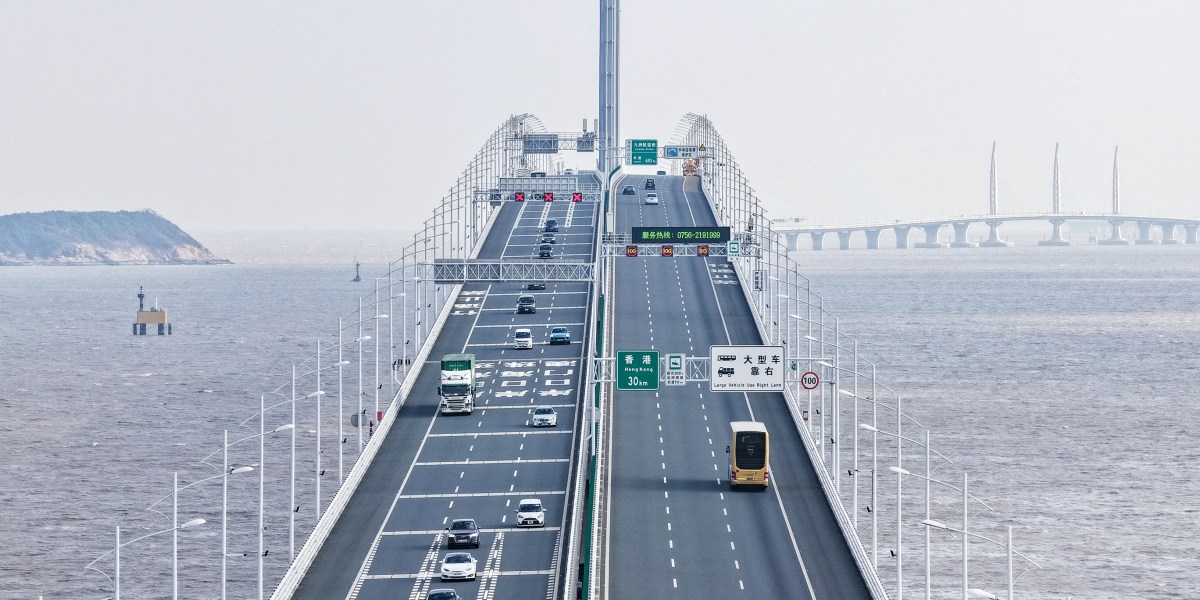
Hengqin is one test of a much larger integration project: the Guangdong–Hong Kong–Macau Greater Bay Area (GBA), which comprises nine cities around the Pearl River Delta in Guangdong province, including Shenzhen, Zhuhai, and Guangzhou, plus the Hong Kong and Macau special administrative regions. Can the GBA turn connectivity and deeper integration into growth?
The GBA spans three legal systems, currencies, and customs territories. With 88 million people, the region has a larger population than Germany or Turkey; with a GDP of $2.1 trillion, its economy approaches Canada’s in size. Connecting the region’s capital, startups, and manufacturing could create a world-class innovation ecosystem.
At least, that’s how the argument goes. Beijing has chased the idea of the GBA for around a decade, but the benefits of integration have only recently begun to emerge. The GBA is real, but it remains a Hong Kong–Shenzhen story for now, pairing the former’s financial heft with the latter’s hardware and software prowess. The next question is whether the other cities will get to join in.
The Pearl River Delta has been one of China’s core economic engines for over four decades…
T…
Inicio del artículo, extracto de Fortune. Para leer el resto, abra el artículo en el sitio del medio.
MarketNews muestra el titular y el resumen publicados por el medio. El artículo completo se lee en el sitio del editor. (fortune.com)