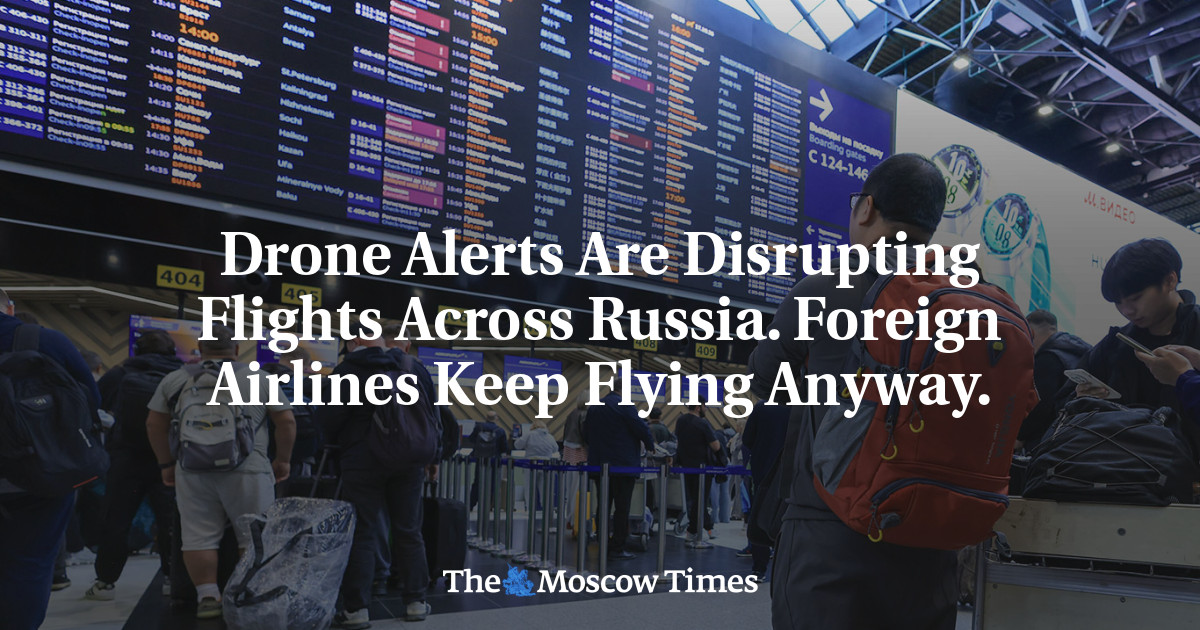
Drone Alerts Are Disrupting Flights Across Russia. Foreign Airlines Keep Flying Anyway.
Resumen detallado
When Vasiliy’s Air Serbia flight from Belgrade descended into Moscow, passengers suddenly faced an unexplained delay.
When Vasiliy’s Air Serbia flight from Belgrade descended into Moscow, passengers suddenly faced an unexplained delay. After circling multiple times over the Russian capital, the plane eventually landed half an hour behind schedule.
Vasiliy later learned that Sheremetyevo Airport had temporarily restricted takeoffs and landings after a series of Ukrainian drone threats.
"We monitored the news from Serbia and took a chance," he told The Moscow Times, asking to be identified by a pseudonym so he could speak freely.
Repeated flight restrictions across Russia in recent weeks — a knock-on effect of Ukrainian aerial attacks and Russia's air defense response — have left passengers scrambling to make connections and airlines diverting aircraft and rearranging crew schedules, analysts and airline staff told The Moscow Times.
That includes the roughly 60 foreign airlines from 37 countries that still serve Russia.
Despite the repeated disruptions, analysts say the routes remain lucrative for some carriers because Western sanctions have left Russian travelers with fewer ways to fly abroad and the airlines that still serve them with less competition.
“At the moment, almost no airlines from continental Europe fly to Russia,” said Serbian aviation expert Petar Vojinovic. “Air Serbia benefits from the strength of its route network and the strategic position of its Belgrade hub.”
After Moscow's full-scale invasion of Ukraine in 2022, Kyiv’s Western allies hit Russia’s aviation sector with sanctions, closed their airspace to Russian carriers and restricted Moscow's access to international aircraft, parts and maintenance.
In response, Russian carriers shifted more of their capacity to domestic flights while expanding international service to countries that did not impose sanctions, like Turkey, Middle Eastern countries and Serbia, said Oleksandr Laneckij, director of the Lithuania-based aviation consultancy Friendly Avia Support.
Inicio del artículo, extracto de The Moscow Times. Para leer el resto, abra el artículo en el sitio del medio.
MarketNews muestra el titular y el resumen publicados por el medio. El artículo completo se lee en el sitio del editor. (www.themoscowtimes.com)