Thangka legacy kept alive
Resumen detallado
A decade ago, Sangye Gyal was a lone artist sitting outside the west gate of Yonghe Lama Temple in Beijing, hunched over a canvas in a 75-sq.-ft. shop stall that served as both…
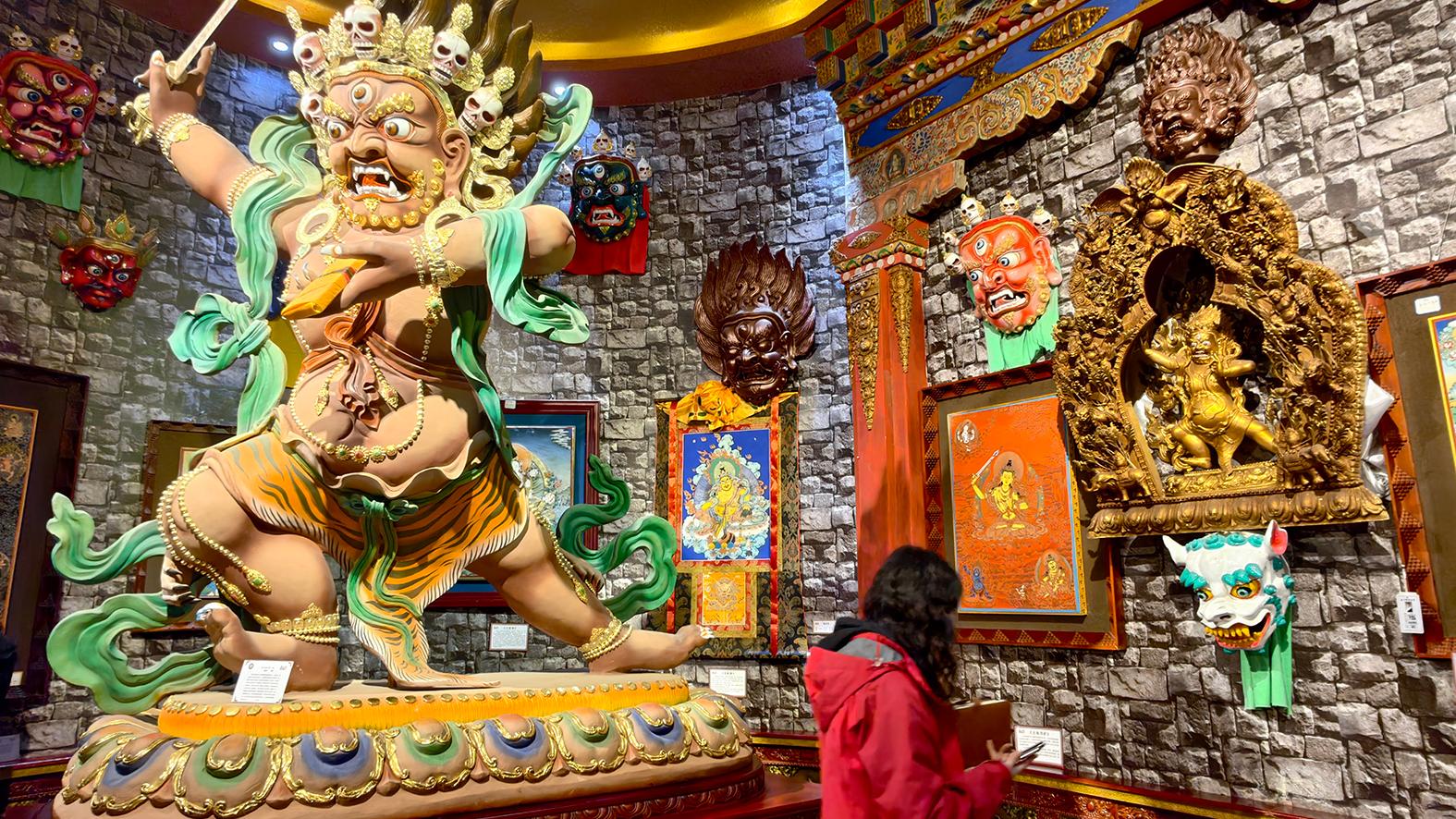
A visitor admires clay sculptures and thangka at a private museum of Regong art in Tongren, Qinghai province. XING WEN / CHINA DAILY
A decade ago, Sangye Gyal was a lone artist sitting outside the west gate of Yonghe Lama Temple in Beijing, hunched over a canvas in a 75-sq.-ft. shop stall that served as both his studio and retail space. There he painted thangka, sold them to passersby, and slowly, patiently, taught a curious public what these sacred scrolls were.
Today, he runs a 40,900-sq.-ft.academy in his hometown of Longwu Town in Tongren, Qinghai province, where more than 80 painters work beneath his roof.
What began in a cramped city booth has grown into a thriving hub that preserves and carries on the sacred painting tradition.
Gyal grew up in Tongren, Huangnan Tibetan autonomous prefecture, where local artisans have passed down Regong (named for a cultural region) art for generations.
Gyal learned thangka painting from a very young age and had developed a solid command of the art by 16. As the Beijing 2008 Summer Olympics approached, a friend invited Gyal, then 22, to attend a folk art expo in Beijing.
He traveled to the capital with his works and five apprentices. During the expo, they sold only one painting, which left a bitter taste in his mouth. He then decided to settle in the metropolis to find more clients and introduce the folk art to a wider, more international audience.
In that 75-sq.-ft. shop, he gradually built a solid client network and accumulated capital.
In 2017, he returned to his hometown to launch the Sangye Thangka Academy and run a Regong art training program that teaches locals how to paint thangka and provides learners with food and accommodation free of charge.
Inicio del artículo, extracto de Time. Para leer el resto, abra el artículo en el sitio del medio.
MarketNews muestra el titular y el resumen publicados por el medio. El artículo completo se lee en el sitio del editor. (time.com)