Tim Cook Could Have Purchased Any of 489 S&P 500 Companies With $903 Billion. Instead, He Bought Something That Transformed Apple Forever.
Resumen detallado
Apple’s former boss purchased what he viewed as the most attractive asset on Wall Street.
This has been a year of historic changes at key leadership positions. Nvidia's (NVDA -5.86%) Jensen Huang recently resigned as CEO, Berkshire Hathaway's (BRKA +0.73%)(BRKB +0.85%) longtime boss, Warren Buffett, retired, and Apple's (AAPL +1.43%) Tim Cook stepped down as CEO on Sept. 1.
The departure of Cook is especially noteworthy, given that Apple has reclaimed the top spot as Wall Street's most-valuable company. Including dividends, Cook oversaw a greater-than-2,700% increase in his company's shares while at the helm and outperformed the benchmark S&P 500 (^GSPC -0.50%) by almost 2,000 percentage points.
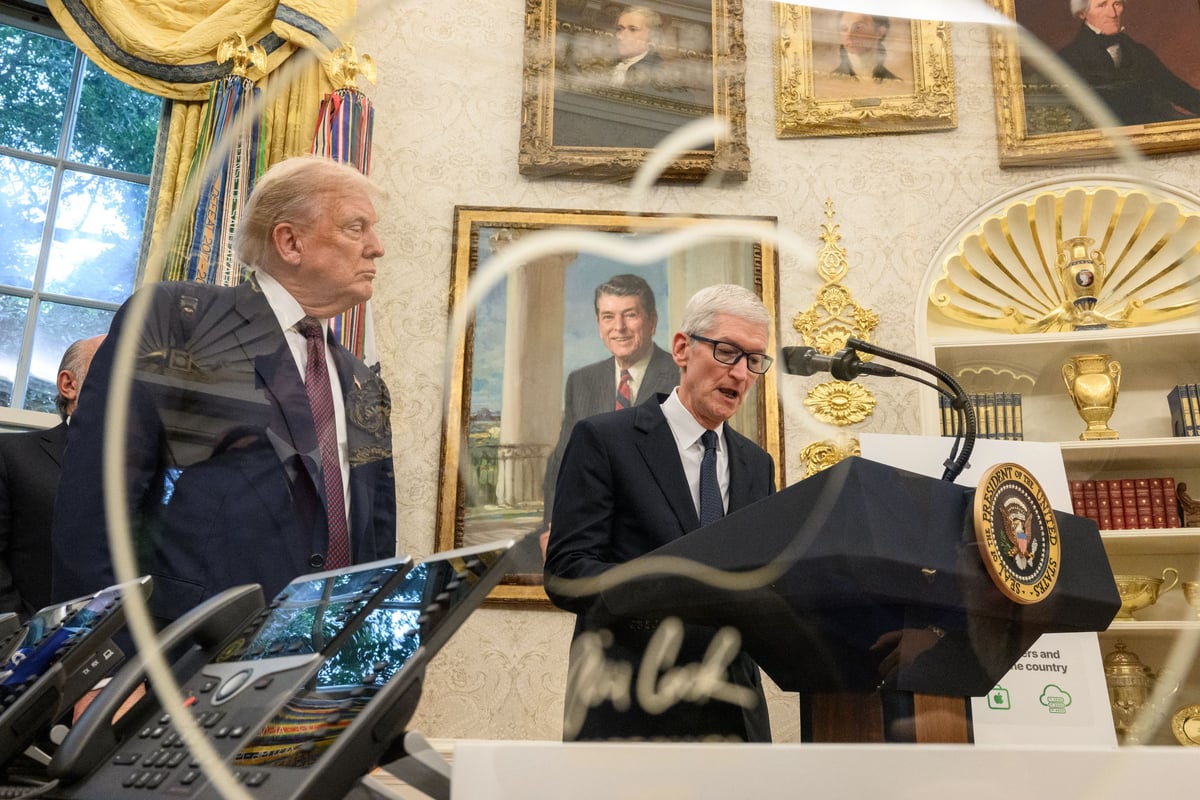
Tim Cook's game-changing investment charted a new course for Apple. Image source: Official White House Photo by Daniel Torok.
Although Apple's innovation is often cited as its greatest growth driver, a nearly $903 billion investment undertaken during Cook's 15-plus-year tenure is what truly changed its path forever.
With $903 billion, Tim Cook could have, in theory, purchased 489 of the 500 companies in the S&P 500, based on their market values as of Nov. 20. This amount of capital could also finance one of the largest artificial intelligence (AI) infrastructure build-outs on the planet.
But Cook chose to invest in something near and dear to his heart. Along with the other board members, Cook kick-started the largest nominal-dollar share repurchase program on Wall Street. Since initiating its buyback program in fiscal 2013, Apple has spent roughly $902.8 billion to repurchase its common stock:
Collectively, Apple has reduced its outstanding share count by 44.79% in 14 years.
Among the factors that fueled share buybacks, arguably none was more important than President Donald Trump's flagship tax and spending law from his first nonconsecutive term, the Tax Cuts and Jobs Act (TCJA).
The TCJA lowered the peak marginal corporate income tax rate from 35% to 21%, marking the lowest peak rate since 1939.
Inicio del artículo, extracto de The Motley Fool. Para leer el resto, abra el artículo en el sitio del medio.
MarketNews muestra el titular y el resumen publicados por el medio. El artículo completo se lee en el sitio del editor. (www.fool.com)