New evidence of Denisovans and unknown ancient humans found in southern China
Resumen detallado
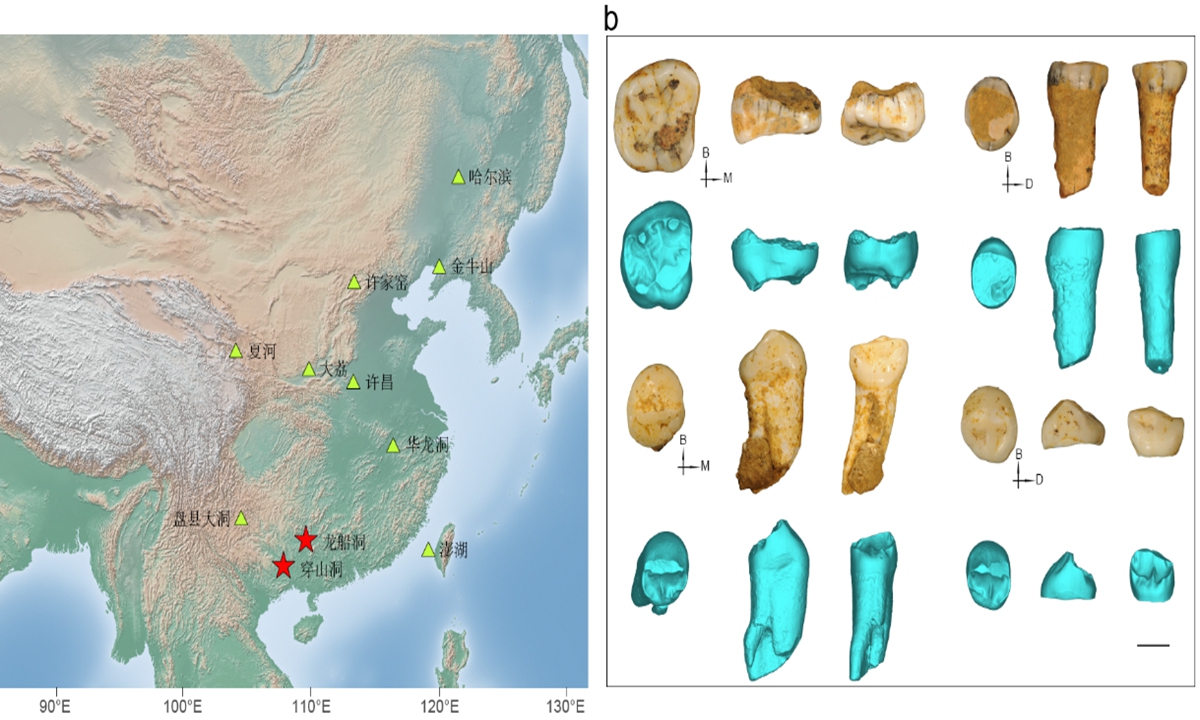
Newly discovered fossils in caves in South China's Guangxi Zhuang Autonomous Region revealed that Denisovans and another previously unknown ancient human lineage may have coexisted in southern China during the Middle and Late Pleistocene, opening new avenues for research into archaic human evolution in East Asia, the Global Times learned from the Institute of Vertebrate Paleontology and Paleoanthropology (IVPP).
Geographic distribution of Chuanshan Cave, Longchuan Cave and other Denisovan sites in East Asia (left), and human teeth (right)
Scientists from China and abroad have confirmed that eight of nine fossils of ancient human teeth discovered from ...
Chinese scientists have identified the Xujiayao hominins, whose fossils were unearthed in North China’s Hebei Province, as Denisovans, ...
As the 21st century discovery of ancient human fossils across China has increased international attention on the origin ...
Inicio del artículo, extracto de Global Times. Para leer el resto, abra el artículo en el sitio del medio.
MarketNews muestra el titular y el resumen publicados por el medio. El artículo completo se lee en el sitio del editor. (www.globaltimes.cn)