Digital twin to help scale and cut costs of giant Australian renewables to hydrogen projects
Resumen detallado
Digital twin for proposed renewables-to-hydrogen nodes could cut costs of massive projects by around 20 per cent.
German technology giant Siemens is to provide the digital engineering technology for a “digital twin” of a patented power-to-hydrogen system that will underpin the massive renewable energy projects being developed by InterContinental Energy in Western Australia.
Siemens and Australia-based automation company Mescada are receiving funding from the Australian Renewable Energy Agency to provide the digital twin for multiple gigawatt-scale nodes that have been designed to harness wind and solar to make green hydrogen and ammonia.
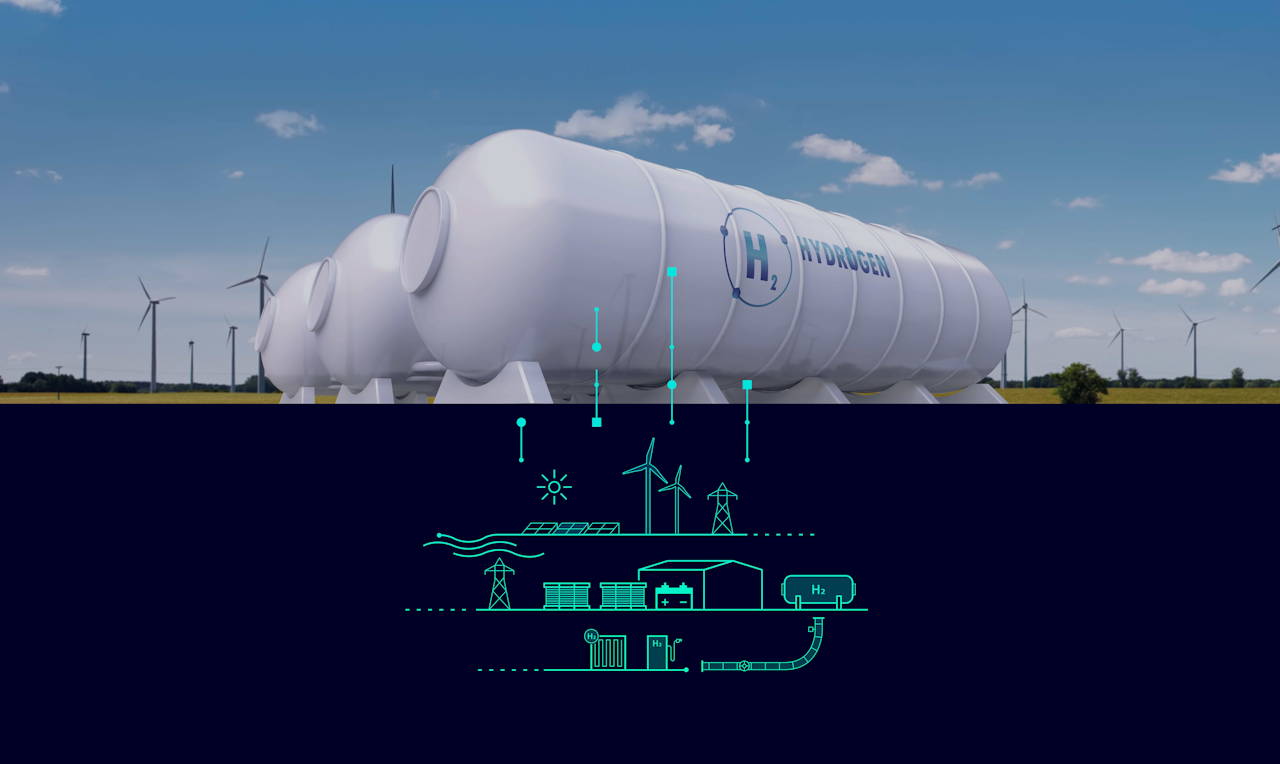
InterContinental’s P2(H2)Node is the basis of its design for the massive projects it is looking at in Western Australia, including the Western Energy Hub in the south of the state, and the Australian Renewable Energy Hub, in the Pilbara.
The P2(H2)Node system aims to standardise green hydrogen architecture and co-locate hydrogen production within wind and solar farms, reducing the production cost of green hydrogen by between 10 to 20 per cent and enabling faster large-scale hydrogen adoption.
Each “node” is designed at gigawatt scale, and typically pairs between 1 and 1.3 gigawatts (GW) of combined AI compute and hydrogen electrolysis with around 2.6 GW of renewable energy generation.
Creating a digital twin of the P2(H2)Node system is also expected to further reduce the cost of hydrogen production by up to 20 per cent by creating a template that can be executed at scale.
The digital twin will allow InterContinental to test and compare different equipment and configurations under changing renewable energy and demand conditions, therefore helping them to identify an optimal design before moving on to front-end engineering design (FEED) and final investment decision (FID).
“Our pioneering projects are at very large scale and in non-metro locations, so we need absolute certainty on design and cost before we commit to construction,” said Isaac Hinton, head of InterContinental Energy in Australia.
“The digital twin allows us to test technologies from…
Inicio del artículo, extracto de RenewEconomy. Para leer el resto, abra el artículo en el sitio del medio.
MarketNews muestra el titular y el resumen publicados por el medio. El artículo completo se lee en el sitio del editor. (reneweconomy.com.au)