Unlocking cancer mysteries by spinning poo
Resumen detallado
The proliferation of self-testing kits, coupled with developments in AI, are helping researchers solve the mysteries of cancer and other diseases ...
Audio player for " Unlocking cancer mysteries by spinning poo " removed for printing
Visit page to play audio: https://www.rnz.co.nz/news/eyJhbGciOiJIUzI1NiJ9._v0.KrRTFtoPsaA8nSDloPZ4KejQJr59ANQpD9ULgGwzaM0/health/2670953%2Funlocking-cancer-mysteries-by-spinning-poo
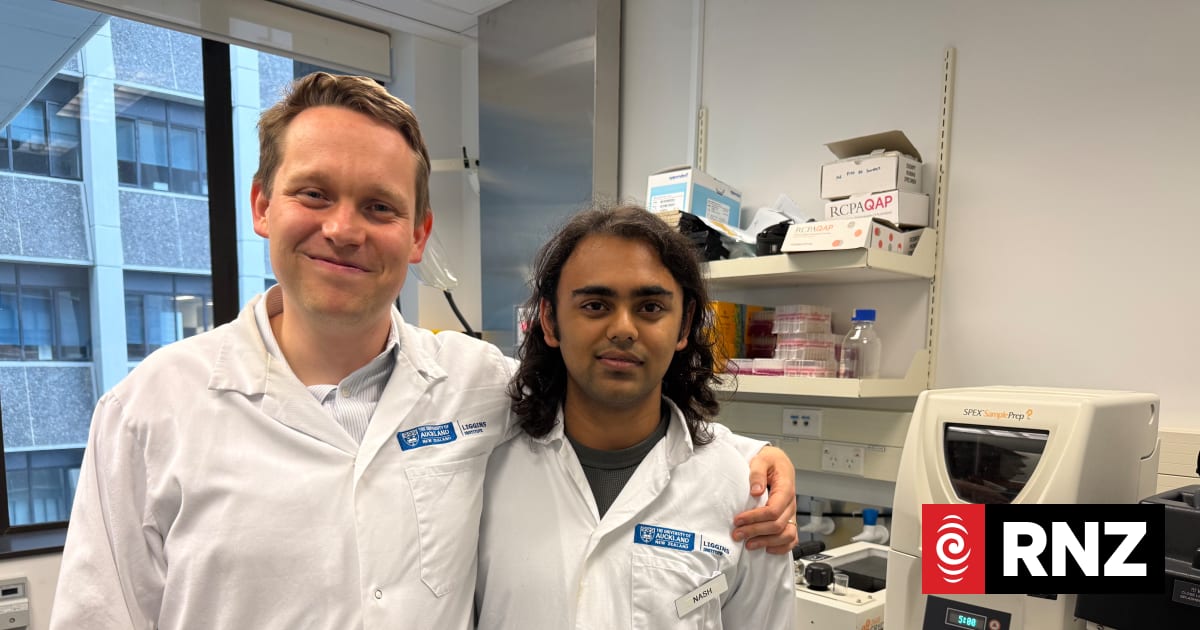
In a laboratory at Auckland University's Liggins Institute, a young Master's student is working on ways to crush our alarmingly high levels of bowel cancer by spinning tiny samples of poo in a machine called a bead beater.
Nash van der Merwe takes the results from the machine and combines them with a special AI programme he's devised.
It's early days in the research but if the intended breakthrough comes, it will be able to detect bowel cancer more accurately than current testing.
"I feel like I'm part of the future now," van der Merwe says. "It's possible we could use it to detect other diseases, other syndromes."
The work comes at a vital time with latest statistics showing New Zealand has the fastest rate of early onset bowel cancer in people under the age of 50 in the world. Last week, comedian Dai Henwood died of it, aged 48.
Research leader Dr Theo Portlock says developments in AI are helping to speed up our understanding of microbiomes - the microorganisms in our bodies and the environment - and their connection with bowel cancer.
"This really is the first time in human history where we've had the computer power necessary to understand how they interact with one another and us, as well as the algorithms, all the AI that's come out recently that allows us to use this data in a way that makes clinical sense," says Portlock, systems biologist and research fellow at Liggins, whose background is in microbiomes.
Inicio del artículo, extracto de RNZ. Para leer el resto, abra el artículo en el sitio del medio.
MarketNews muestra el titular y el resumen publicados por el medio. El artículo completo se lee en el sitio del editor. (www.rnz.co.nz)