As climate change creates ‘disasters on steroids’, it’s time we asked: what happens after an evacuation?
Résumé détaillé
Evacuations are often presented as purely protective – and sometimes they are. But they can also exacerbate existing risks and even generate new forms of harm.
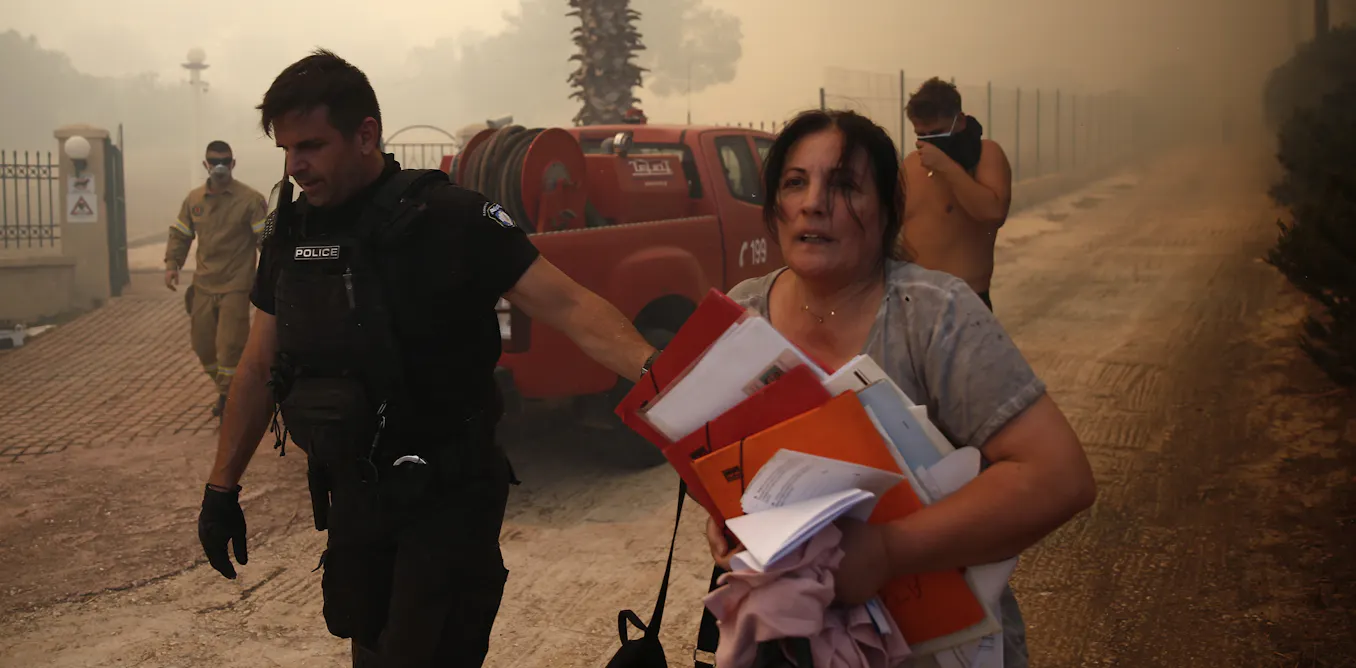
Evacuation is one of our oldest and most instinctive responses to danger. Whether the threat is fire, flood, conflict or another emergency, the imperative is to get people out of harm’s way.
Recent examples abound. In July, more than 200,000 people fled catastrophic wildfires near Bordeaux in what was France’s largest evacuation since the second world war.
A few years earlier, a single cyclone prompted five million evacuations across Bangladesh, India, Myanmar and Bhutan.
And millions of people have been evacuated from conflicts in Palestine, Lebanon, Afghanistan and Ukraine in recent years, to name just a few.
But sometimes, the real disaster is what happens next. Once people have escaped immediate danger, further challenges arise. How long will people be displaced? Where will they live, and in what conditions? What will their legal status be if they cross an international border? What if they can never return home?
Such questions are becoming increasingly urgent as climate change creates disasters on steroids. Between 2015 and 2022, more than 2.1 billion people globally were evacuated in anticipation of hazards. While many returned quickly, others were displaced for months or even years. For some, going home still isn’t an option.
Despite this, surprisingly little attention has been paid to evacuations as a form of displacement. Evacuation tends to be seen as a temporary emergency management tool, rather than as a social and political process that can exacerbate vulnerability and affect people’s lives for years to come.
This is where history may offer some interesting lessons, and in unexpected ways.
When we think about the origins of refugee protection, we tend to think of the second world war and the subsequent creation of the 1951 Refugee Convention. But the foundations of the international refugee protection regime were laid much earlier – and evacuations played a central role.
Début de l'article, extrait de The Conversation AU. Pour lire la suite, ouvrez l'article chez le média.
MarketNews présente le titre et le résumé publiés par le média. L'article complet se lit sur le site de l'éditeur. (theconversation.com)