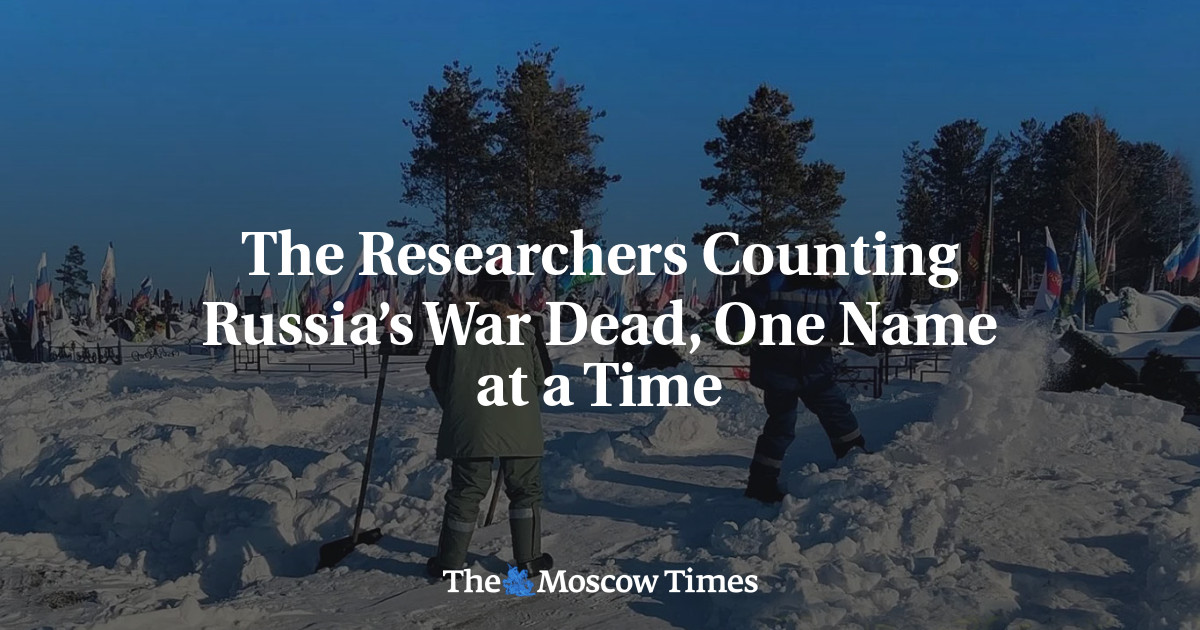
The Researchers Counting Russia’s War Dead, One Name at a Time
Detailed summary
For Andrew, the hardest part of counting Russia’s war dead isn’t reading through the grim stories of how soldiers perished on the battlefield or the often sordid details of their…
For Andrew, the hardest part of counting Russia’s war dead isn’t reading through the grim stories of how soldiers perished on the battlefield or the often sordid details of their backgrounds.
It’s thinking of the children whose lives are forever changed by the conflict, like the seven-year-old girl who wrote “please come back” on her father’s social media page.
“It pains me to realize that the lives of all these people could have turned out differently in another country,” he said. “Russia, as a political and social system, bears responsibility for this human tragedy.”
Andrew is part of the small but dedicated community of researchers, journalists and volunteers whose goal is to pin down the elusive number of Russian soldiers who have died in the war with Ukraine. Because he is based in Russia, where such work carries the risk of jail time, Andrew requested anonymity to speak freely.
It’s an imperfect science relying on data analysis, risky on-the-ground verification and combing through web pages and social media feeds for evidence, like newly inaugurated war memorials and social media tributes from grieving relatives.
Even with automation, the process is time-consuming. But those who do it say the work matters, both for the public’s understanding of the war and for the Russians who have lost family members to it.
“Unfortunately, there were dozens and dozens of cases where relatives learned about their loved ones not from officials, not from Wagner, but from us,” said Olga Ivshina, a journalist for BBC Russian, which has tracked casualties since the start of the war.
“Some are angry at the commanders, some are angry at the higher chain of command, some are angry at the officials. But then later on, most of them started saying ‘well, it was destiny,’ trying to find some meaning in it,” she said.
The extensive legwork put in by volunteers and journalists is a product of the Russian government’s silence around the issue.
Opening of the article, excerpted from The Moscow Times. To read the rest, open the article on the publisher's site.
MarketNews shows the headline and summary published by the outlet. The full article is on the publisher's website. (www.themoscowtimes.com)