Astronomers spot record-setting quasar in the early universe
Detailed summary
WASHINGTON: A quasar, one of the universe's most energetic and luminous objects, is the enormously bright core of a galaxy, powered by ...
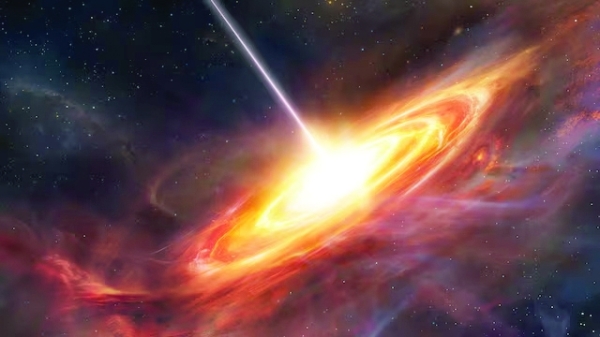
WASHINGTON: A quasar, one of the universe's most energetic and luminous objects, is the enormously bright core of a galaxy, powered by a central supermassive black hole. Astronomers have now found the oldest-known quasar, one that formed so early in cosmic history that they are still trying to decipher how it happened.
They identified a quasar dating to more than 13.1 billion years ago when the cosmos was less than 5 per cent of its current age, some 630 million years after the Big Bang event that initiated the universe. The quasar dates to 40 million years earlier than the previous record holder, disclosed in July.
"I think it adds to the evidence that some objects in the early universe developed remarkably quickly. Just 630 million years after the Big Bang, this black hole had already grown to about 360 million times the mass of the Sun and was shining as a quasar," said astronomer Julien Wolf of the European Southern Observatory in Germany, the lead author of the research published in the journal Astronomy and Astrophysics.
Black holes are extraordinarily dense objects with gravity so strong that not even light can escape.
The quasar was first detected by the European Space Agency's Euclid orbiting telescope and then further characterised using a combination of ground- and space-based telescopes.
The researchers gave the quasar the nickname Dún Aonghasa, the name of an ancient stone fort in Ireland that is perched atop a cliff overlooking the vast expanse of the Atlantic Ocean.
A supermassive black hole that powers a quasar is typically billions of times more massive than the Sun.
"As enormous amounts of gas, dust and matter fall towards the black hole, they form a swirling accretion disk that heats up to extreme temperatures and radiates tremendous amounts of energy, outshining the entire rest of the galaxy by factors of hundreds or even thousands," said astronomer and study co-author Silvia Belladitta of the Max Planck Institute for Astronomy in Germany and…
"…
Opening of the article, excerpted from Oman Observer. To read the rest, open the article on the publisher's site.
MarketNews shows the headline and summary published by the outlet. The full article is on the publisher's website. (www.omanobserver.om)