Global powers converge on Manila as ASEAN summit kicks off
Detailed summary
Myanmar has been excluded from high-level ASEAN meetings since a 2021 military coup that ousted the elected government of Aung San Suu Kyi and triggered an ongoing civil war.
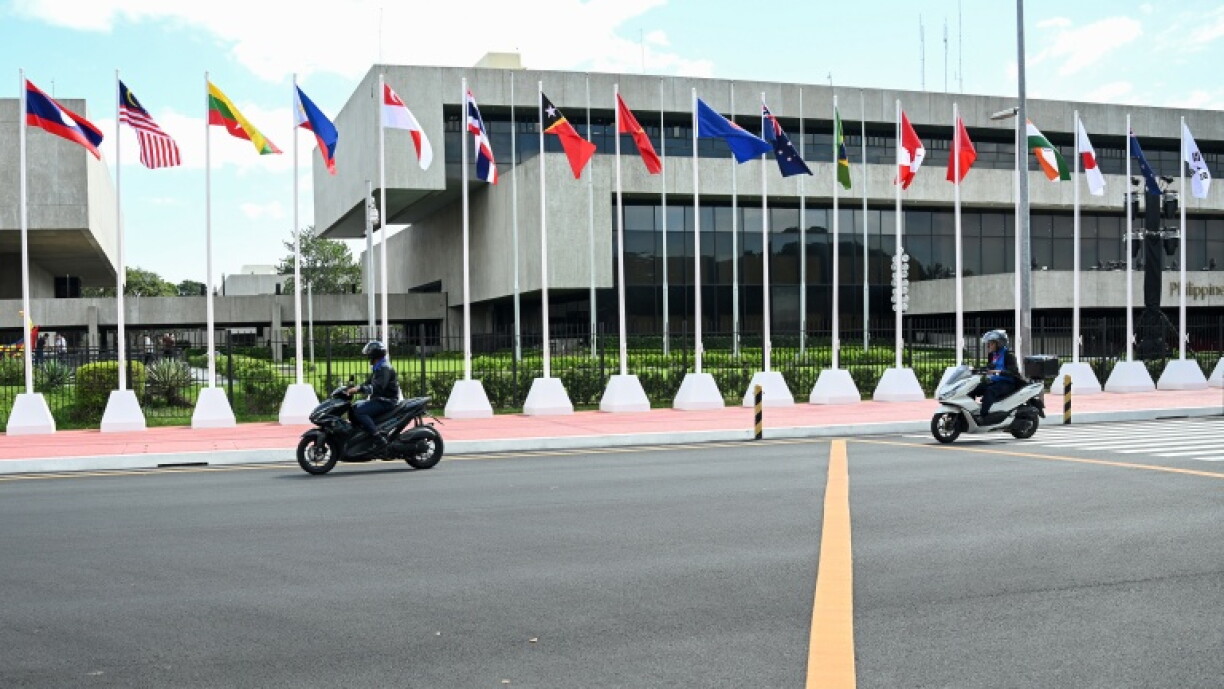
A key regional summit opens on Sunday in Manila, with Southeast Asian heads of state facing questions on trade, security and an ongoing energy crisis while playing host to a who's who of global leaders.
US President Donald Trump is scheduled to arrive on Tuesday near the summit's conclusion, a visit expected to include a sideline meeting with fellow Quad countries India, Japan and Australia -- the first of his second term.
The meeting of the Quad -- a grouping broadly aimed at counterbalancing China's regional influence -- would come days before a historic sit-down with Chinese leader Xi Jinping and Russia's Vladimir Putin in Shenzhen.
Brazil's recently re-elected Luiz Inacio Lula da Silva, meanwhile, is set to attend a plenary session of the 11-member Association of Southeast Asian Nations (ASEAN) on Sunday, while Australian Prime Minister Anthony Albanese will sign a new defence pact with host country the Philippines.
Nearly 20,000 police officers have been deployed around Metro Manila for the summit, with progressive groups predicting a turnout of thousands on Tuesday for an anti-Trump march on the summit site.
Much of the uproar targets the US Pax Silica programme -- a supply-chain initiative designed to counter China's dominance in semiconductors and rare earths -- whose flagship Philippine project, a 1,620-hectare AI manufacturing hub north of Manila, threatens to displace Indigenous families.
US Ambassador to the Philippines Lee Lipton said last week that a widely rumoured November target date for a deal signing timed to Trump's visit was never in the works.
A day of early meetings kicked off on Saturday with Canadian Prime Minister Mark Carney announcing a Philippine trade deal, and ASEAN leaders huddling on key issues including haze from Indonesia and potential fuel-sharing schemes as members struggle with Iran war-driven shortages.
But two issues that have vexed ASEAN leaders for years -- a languishing South China Sea "Code of Conduct" and their relationship with…
Opening of the article, excerpted from RTL Today. To read the rest, open the article on the publisher's site.
MarketNews shows the headline and summary published by the outlet. The full article is on the publisher's website. (today.rtl.lu)