Discoveries from a 125,000-year-old lakeshore reveal life in a greener Arabia
Résumé détaillé
Tools, plants and animal remains found in the desert reveal a lush landscape where people once thrived.
A fossil hippo tooth is an unlikely find in the middle of a desert. The vast sandy expanse of Arabia’s Empty Quarter or Rub’ al Khali stretches across the southern part of the peninsula, covering parts of Saudi Arabia, Oman, Yemen and the United Arab Emirates. Yet its ancient sands preserve evidence of a very different landscape.
About 125,000 years ago, a freshwater lake filled the Mundafan basin in southern Saudi Arabia. Hippos lived in its waters, while giant buffalo, gazelles and oryx roamed the surrounding grasslands.
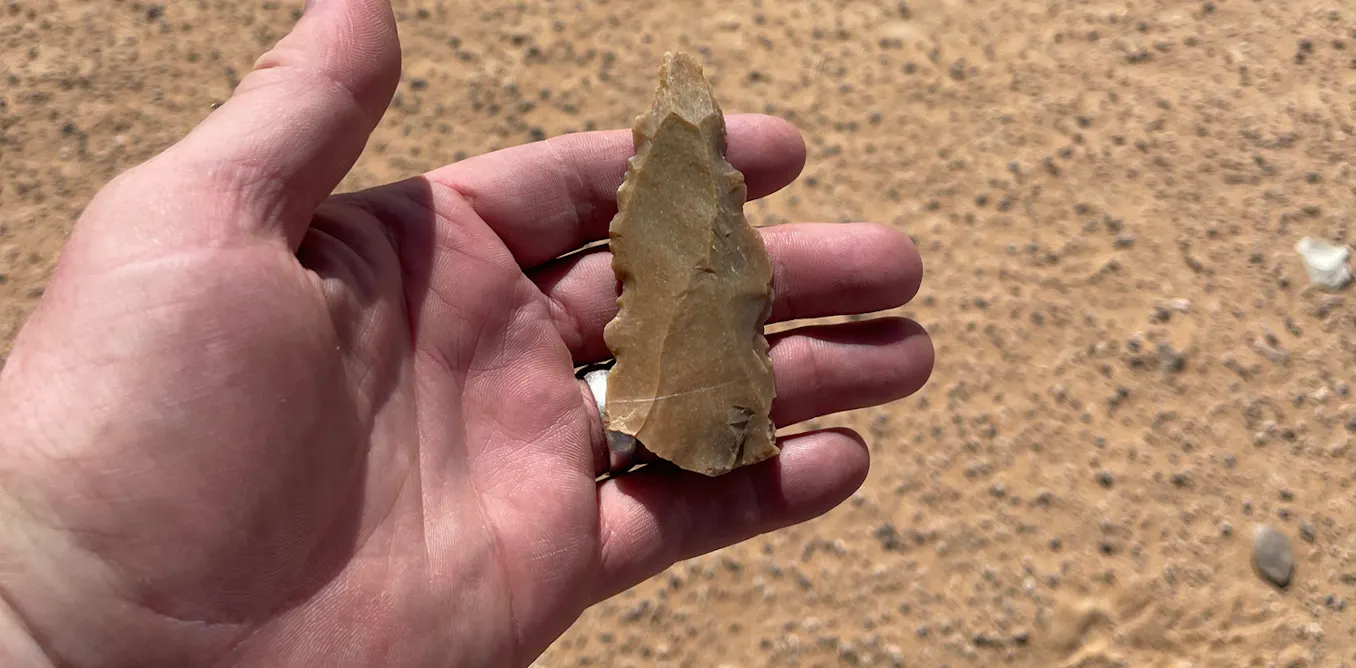
People lived and worked along the shore, leaving behind stone tools that still preserve microscopic traces of their activities.
Our new study, published in Science, reveals how these people made hunting weapons and processed plants. Chemical traces on some stone points suggest they used plant poisons to hunt.
These findings offer a rare view of life in Arabia during an early period of human expansion beyond Africa. They help us understand the skills and resources that allowed humans to live in a place now dominated by desert.
Our species evolved in Africa, where fossils show early Homo sapiens existed by about 300,000 years ago. Our subsequent expansion into other continents involved repeated movements, with many questions about their timing and consequences still unresolved.
Fossils show our species reached parts of Asia well before the major expansion about 60–70,000 years ago. Homo sapiens fossils in Greece and Israel, for example, place our species outside of Africa by about 200,000 years ago, while a human finger bone from northern Arabia places Homo sapiens on the Arabian peninsula at least 85,000 years ago.
Researchers continue to debate which routes people took and how these earlier populations relate to later ones.
Arabia occupies a central position between Africa and Asia. Earlier research documents repeated human occupation over the past 400,000 years, involving different human groups during wetter climatic phases.
Début de l'article, extrait de The Conversation AU. Pour lire la suite, ouvrez l'article chez le média.
MarketNews présente le titre et le résumé publiés par le média. L'article complet se lit sur le site de l'éditeur. (theconversation.com)