Spaniards vote in contentious election that could see far-right gains
Detailed summary
Embattled left-wing Prime Minister Pedro Sánchez is fighting for his political survival.
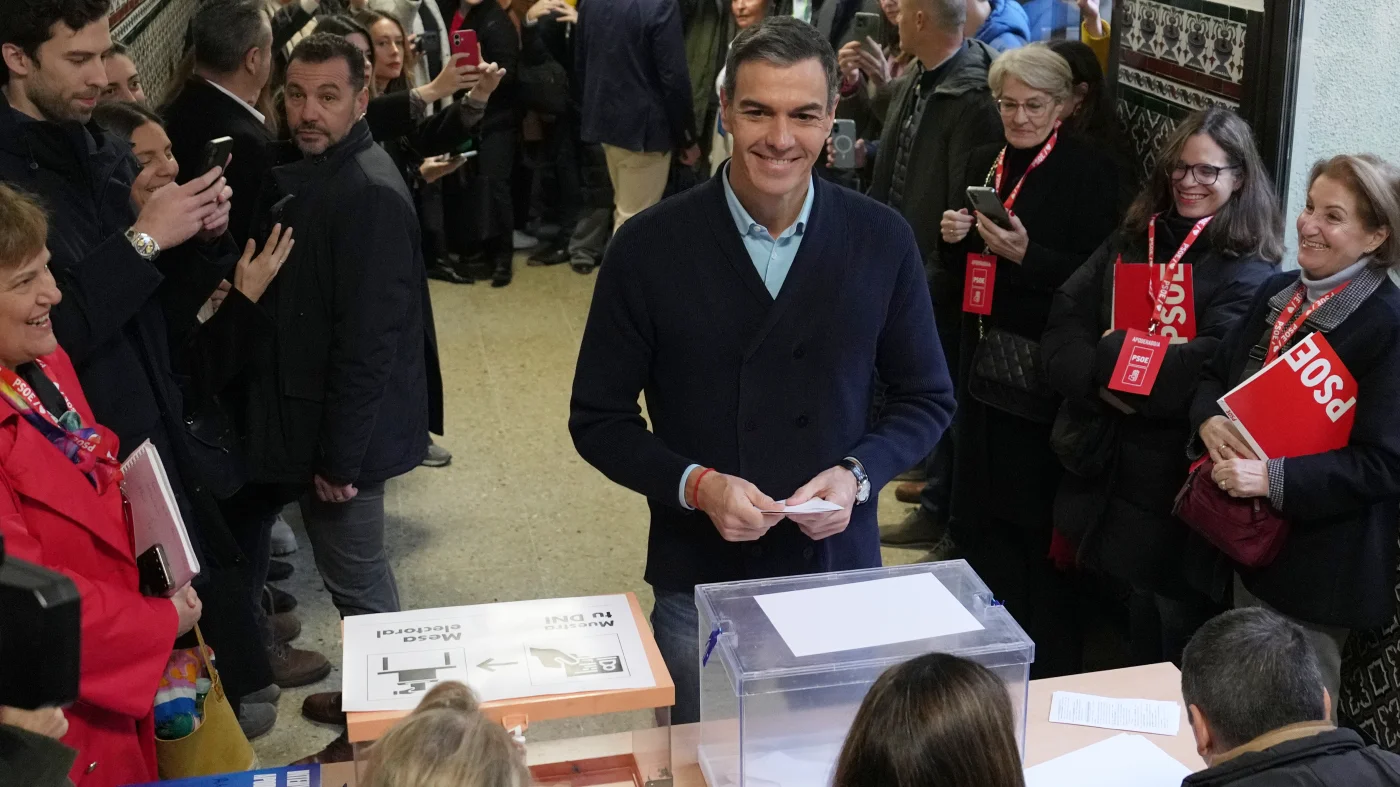
Spain's incumbent Prime Minister Pedro Sanchez votes in Spain's general election at a polling station in Madrid, Spain, Sunday, Nov. 29, 2026. Francisco Seco/AP hide caption
SEVILLE, Spain — Polls opened Sunday in what's gearing up to be one of the most fiercely contested elections in polarized Spain's recent history.
Embattled Prime Minister Pedro Sánchez, leader of the Spanish socialist party, is fighting for his re-election. However, opposition leader Alberto Núñez Feijóo, of the conservative Partido Popular, is leading in the polls.
But with neither of the two main parties expected to secure a majority to form a government, Santiago Abascal, of the rising far-right VOX party, has emerged as a potential kingmaker. It would be the first time the far-right was part of a national government since the end of Spain's dictatorship in 1975.
Sánchez is touting his progressive policies and calling for voters on the left to stop the far-right.
The right paints Sánchez as authoritarian and are urging their base to push him out of office and walk back some of his policies on taxes, labor reform, housing and abortion.
Popular Party candidate Alberto Nunez Feijoo waves to supporters during a campaign rally ahead of the general election in Madrid, Spain, Wednesday, Nov. 25, 2026. Francisco Seco/AP hide caption
"After 8 years in power Pedro Sánchez is quite unpopular," Maria Ramirez, deputy managing editor of the online news site el diario, told NPR.
"He is a good strategist and his strategy now is probably mobilizing his base on the left and his narrow path to victory depends on that," she added.
Opening of the article, excerpted from NPR. To read the rest, open the article on the publisher's site.
MarketNews shows the headline and summary published by the outlet. The full article is on the publisher's website. (www.npr.org)