New study reveals a close‑up of NZ’s Alpine Fault – and how the next big quake might unfold
Résumé détaillé
A detailed image of the Alpine Fault shows narrow zones of crushed rock where previous large earthquakes likely started – and a future one may kick off.
The 600-kilometre Alpine Fault is one of New Zealand’s largest earthquake hazards. In our new study, we used fibre optic cables to map the fault in unprecedented detail to show how future earthquakes might unfold.
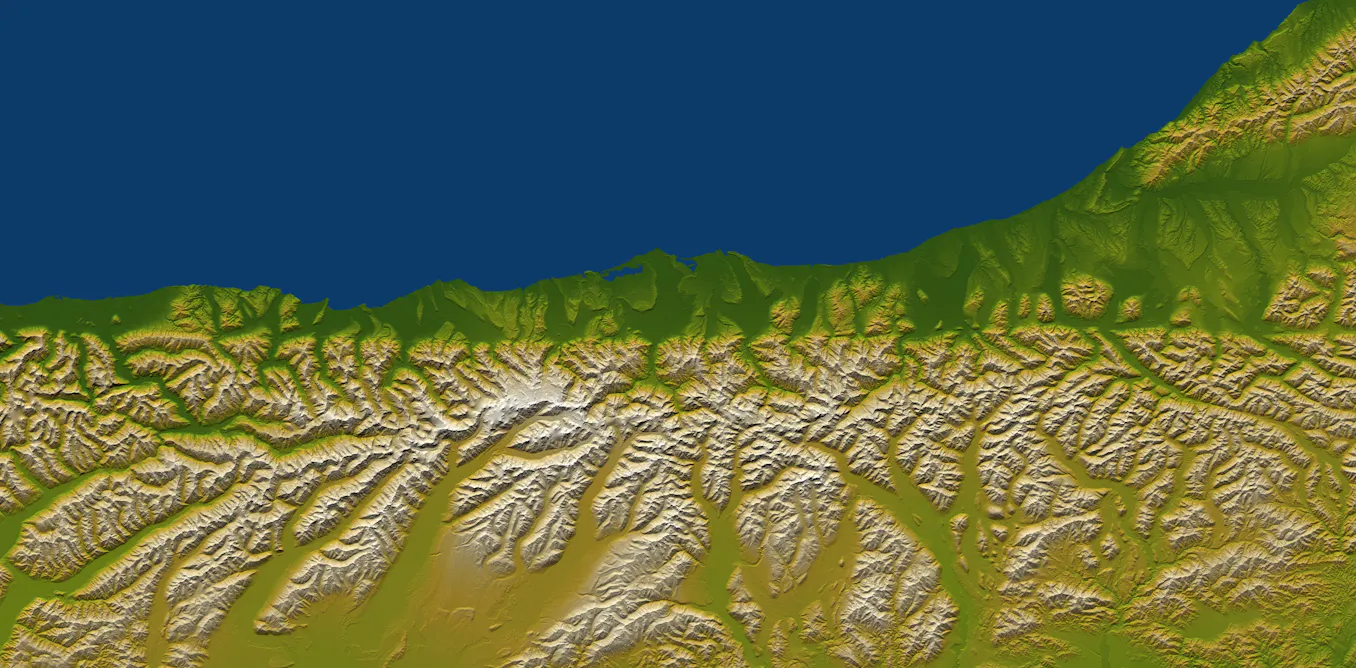
The Alpine Fault runs the length of the Southern Alps and defines the boundary between the Australian and Pacific tectonic plates. It has been the focus of extensive geological, seismological and drilling investigations in recent years because it produces very large (magnitude 7-8) earthquakes about every 300 years.
With the most recent earthquake in 1717, scientists estimate there’s a 75% chance of a large one in the next 50 years, with high odds it will be larger than magnitude 8.
In anticipation of that event, several research groups are working hard to understand how the Alpine Fault is being loaded prior to its next rupture and how its geometry and physical characteristics may affect an earthquake’s propagation and the resulting ground shaking.
Our focus is on determining the fault’s geometry and internal structure at scales much finer than can be studied using conventional seismometers, which are usually spaced tens of kilometres apart.
Instead we used a standard telecommunications cable to reveal the fault’s internal detail. Our study shows the fault is not a single clean crack but rather a band of damaged rock about 200 metres wide.
Within it, we found six much narrower zones of more intensely crushed and sheared rock. We call these “cores” and think the most prominent core is where the fault slipped during recent large earthquakes.
This matters because an earthquake’s size depends mainly on how much of the fault breaks. Understanding the fault’s structure helps us work out how much could break at once, and how large the next big earthquake might be.
We send pulses of laser light down an optical fibre in a cable installed by telecommunications company Chorus near Haast. This turns the cable into a long line of sensitive earthquake sensors.
Début de l'article, extrait de The Conversation AU. Pour lire la suite, ouvrez l'article chez le média.
MarketNews présente le titre et le résumé publiés par le média. L'article complet se lit sur le site de l'éditeur. (theconversation.com)