They were in high school when ChatGPT arrived and in college when their friends got accused of cheating. Now their AI software polices 40 colleges
Detailed summary
Four Purdue students built Syntax, which records how an essay gets written. Teachers get the evidence. Students can buy it for $9.99.
When OpenAI released ChatGPT on Nov. 30, 2022, Derin Suzener was a high school senior already leaning toward a career in AI. He got there “without having taken a single computer science course back in 11th grade,” he told Fortune. “I did not start using ChatGPT until I entered university, actually.”
Nikita Kravcenko, his future cofounder, was also in high school, taking AP classes where “my teachers were bombarding students with anti-AI policy, because it was like a new technology at that point,” he said. “So they were very fearful of what it could do and write. So they were essentially having a craze over it.”
By the time they got to Purdue, the craze had casualties. “I was seeing all of my friends get accused of cheating with AI on their computer science assignments,” Suzener said. “And they would have a pretty hard time proving it, actually.”
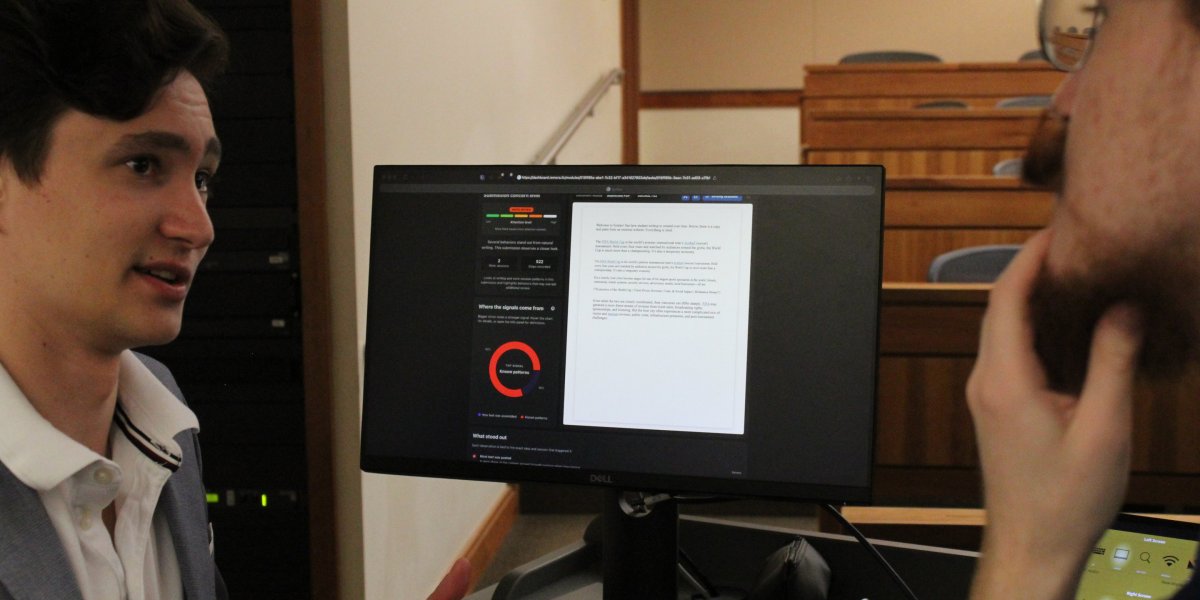
So Suzener, Kravcenko and two classmates built a way to prove it. Their company, Remora, makes Syntax, a document editor that records how a student writes a paper (typing speed, cursor movement, what gets pasted in) and flags anything odd for the teacher to review. The founders say it’s used in classrooms at 40 U.S. colleges and universities, though they declined to name any, saying that identifying customers could help larger competitors go after the same schools. The company says four more institutions will start using it next semester. Students can also buy it themselves, starting at $9.99 for three months.
The pitch is protection for students who did their own work. “The guilty are truly proven to be guilty, and then the innocent are exonerated,” Kravcenko said. The fear is common. In a YouGov poll of 2,373 UK students, commissioned by the student-support company Studiosity, 52% named “being accused of cheating when I did nothing wrong” as one of the things stressing them out, Times Higher Education reported in February.
Kravcenko, the company’s CFO, is a third-year finance and accounting student at Purdue’s Daniels School…
Opening of the article, excerpted from Fortune. To read the rest, open the article on the publisher's site.
MarketNews shows the headline and summary published by the outlet. The full article is on the publisher's website. (fortune.com)