China hands over remains of US airmen found along WWII Hump Route
Résumé détaillé
Chinese honor guards walked forward, carrying a box containing human remains. US honor guards stepped up to receive it and carefully placed an American national flag over the box.
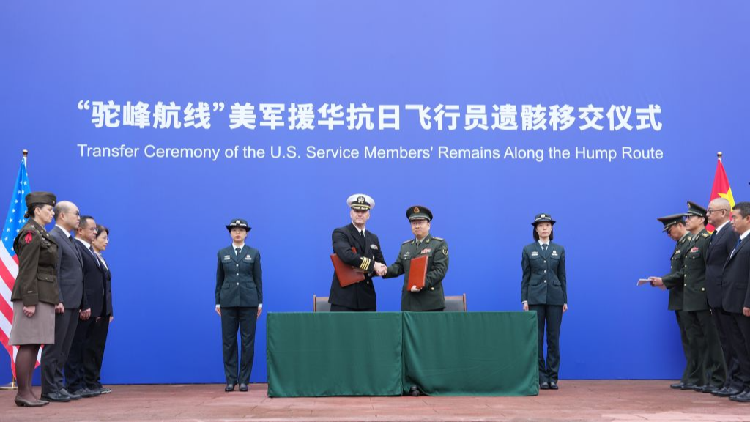
A document confirming the transfer of the US airmen remains found along Hump Route is signed, witnessed by Chinese and American representatives, during a handover ceremony in Chengdu, southwest China's Sichuan Province, November 10, 2026. /Xinhua
Chinese honor guards walked forward, carrying a box containing human remains. US honor guards stepped up to receive it and carefully placed an American national flag over the box.
The box held eight bone fragments recovered from a glacier more than 5,000 meters above sea level. The remains, believed to belong to US airmen who went missing along the Hump Route during World War II (WWII), had lain in the mountains for more than 80 years.
At the handover ceremony in Chengdu, southwest China's Sichuan Province, on Tuesday, He Jiang, director of the Chinese People's Liberation Army Archives, and US Navy Captain Colin Alexander Eliot, a forensic expert with the Defense POW/MIA Accounting Agency (DPAA), signed a document confirming the transfer, witnessed by Chinese and American representatives.
Chinese honor guards handover the box containing the US airmen remains found along Hump Route during a handover ceremony in Chengdu, southwest China's Sichuan Province, November 10, 2026. /Xinhua
The remains were recovered in areas along the Hump Route, which was established after Japanese forces occupied Myanmar in 1942, cutting off the Yunnan-Myanmar road, China's last major overland supply link to the outside world.
Stretching from the state of Assam in northeastern India to Kunming in southwest China, the air corridor across the Himalayas became a vital lifeline for Allied supplies supporting China's resistance against Japanese aggression from 1942 to 1945.
The route crossed snow-covered mountains, deep gorges, glaciers and tropical forests. Violent air currents, low air pressure, hail and freezing conditions posed constant risks to aircraft flying through the region. It became known as the "death route."
More than 1,000 Chinese and American…
Début de l'article, extrait de CGTN. Pour lire la suite, ouvrez l'article chez le média.
MarketNews présente le titre et le résumé publiés par le média. L'article complet se lit sur le site de l'éditeur. (news.cgtn.com)