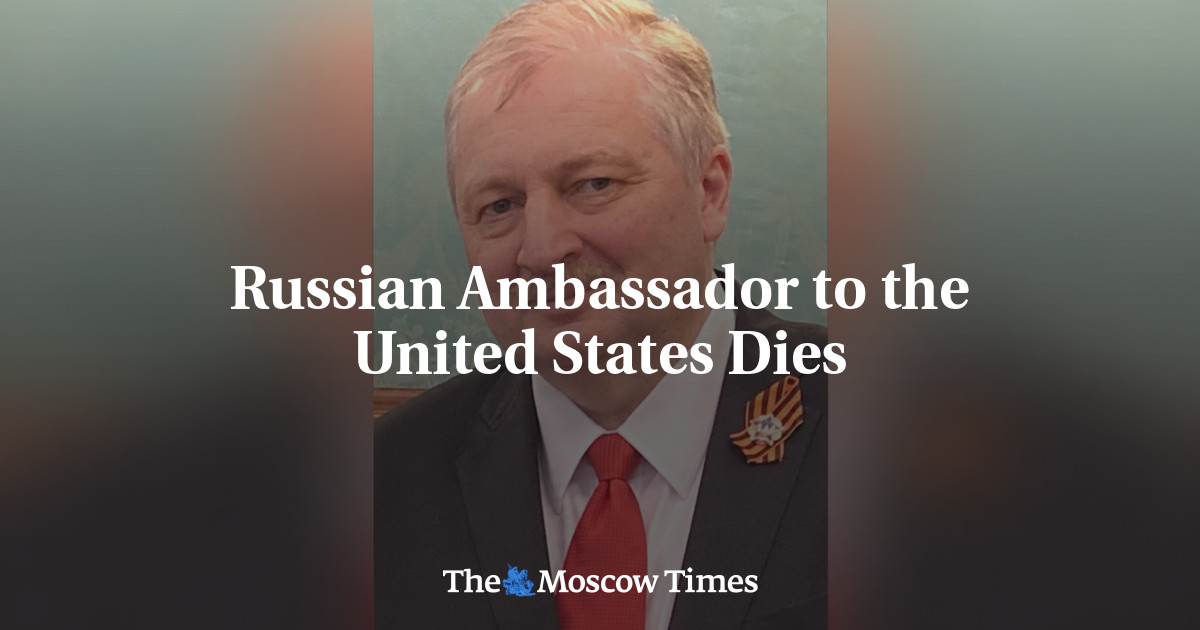
Russia’s Ambassador to the United States Dies at 66
Detailed summary
Russia’s Ambassador to the United States, Alexander Darchiev, has died at the age of 66, the Russian Foreign Ministry said Wednesday. “An outstanding diplomat, experienced leader,…
Russia’s Ambassador to the United States, Alexander Darchiev, has died at the age of 66, the Russian Foreign Ministry said Wednesday.
“An outstanding diplomat, experienced leader, kind colleague and mentor has passed away,” the ministry said in a brief statement, describing the late ambassador as a “professional of the highest order and a brilliant expert on American affairs.” It did not disclose the cause of Darchiev’s death.
Darchiev replaced Anatoly Antonov as ambassador to the United States in early 2025 amid a sudden thaw in U.S.-Russia relations following President Donald Trump’s return to the White House.
A seasoned diplomat, Darchiev previously served at Russia’s Embassy in Washington in the late 2000s before holding positions in the Foreign Ministry. He later spent six years as Russia’s ambassador to Canada and headed the ministry’s North American Department for four years.
Darchiev was a protegé of President Vladimir Putin’s foreign policy adviser Yury Ushakov, according to Boris Bondarev, a former Russian diplomat in Geneva who publicly resigned in protest of the invasion of Ukraine.
At the time of his appointment, observers said they did not believe Darchiev was likely to wield much influence, as Moscow and Washington have handled most major issues at a higher level in recent years.
The Kremlin did not immediately comment on Darchiev’s passing. U.S. officials have also not issued any statements.
We are facing unprecedented challenges. Russia's Prosecutor General's Office has designated The Moscow Times as an "undesirable" organization, criminalizing our work and putting our staff at risk of prosecution. This follows our earlier unjust labeling as a "foreign agent."
These actions are direct attempts to silence independent journalism in Russia. The authorities claim our work "discredits the decisions of the Russian leadership." We see things differently: we strive to provide accurate, unbiased reporting on Russia.
Opening of the article, excerpted from The Moscow Times. To read the rest, open the article on the publisher's site.
MarketNews shows the headline and summary published by the outlet. The full article is on the publisher's website. (www.themoscowtimes.com)