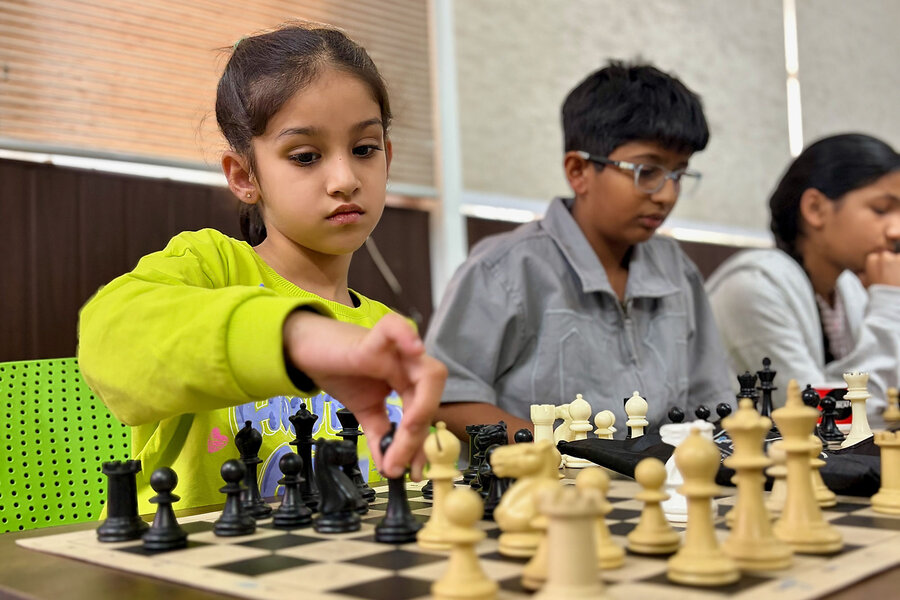
Why more Indian families are making chess their next move
Résumé détaillé
India’s second world chess champion defends his title in Geneva this week, as the game’s popularity skyrockets back home.
India’s second world chess champion defends his title in Geneva this week, as the game’s popularity skyrockets back home.
Naveen Bansal couldn’t understand what his grandmother had given him for his 10th birthday: a folding cardboard mat marked with black-and-white squares and a jumble of plastic pieces. His grandmother didn’t know, either. She had just asked a toy-shop owner for an inexpensive gift for her shy grandson.
Curious, Naveen carried the puzzle around the neighborhood until someone recognized it as a chess set. The boy’s friends gathered around as a neighbor taught him the basics.
That was 1985. Today, Mr. Bansal runs a chess academy in the northern city of Chandigarh, India, training hundreds of students in the game. Over the past three decades, he’s watched chess rocket into the mainstream in India – and it’s still growing.
In India, chess is becoming a core part of many parents’ hopes and aspirations for their children’s future. One chess academy in Chandigarh shows how this centuries-old game slid back into Indian culture – and what it takes to foster young talent.
This month, Anuj Shrivatri became the country’s 100th grandmaster, the highest lifelong title awarded by the International Chess Federation, or FIDE. The federation’s 2026 World Chess Championship kicked off in Geneva on Tuesday, in which reigning champion Gukesh Dommaraju – a Chennai native who became the youngest undisputed world champion at 18 – is defending his title against Uzbekistan’s Javokhir Sindarov. The 14-game match (Game 1 ended in a draw) is being followed closely by chess enthusiasts throughout India, including many parents who have come to view this tactical board game as an important part of their children’s development.
“Chess is increasingly becoming part of Indian culture,” says Mr. Bansal.
Chess is widely believed to have originated in India. An early form of the game, known as chaturanga, was played here more than 1,000 years ago, before spreading west through Persia and…
Whil…
Début de l'article, extrait de The Christian Science Monitor. Pour lire la suite, ouvrez l'article chez le média.
MarketNews présente le titre et le résumé publiés par le média. L'article complet se lit sur le site de l'éditeur. (www.csmonitor.com)