EXPLAINER: What is the ASEAN Digital Economy Framework Agreement?
详细摘要
'DEFA will facilitate paperless trading, cross-border e-commerce, and trusted cross-border data flows, and it will establish interoperable trade systems,' says ASEAN Secretary-General Kao Kim Hourn
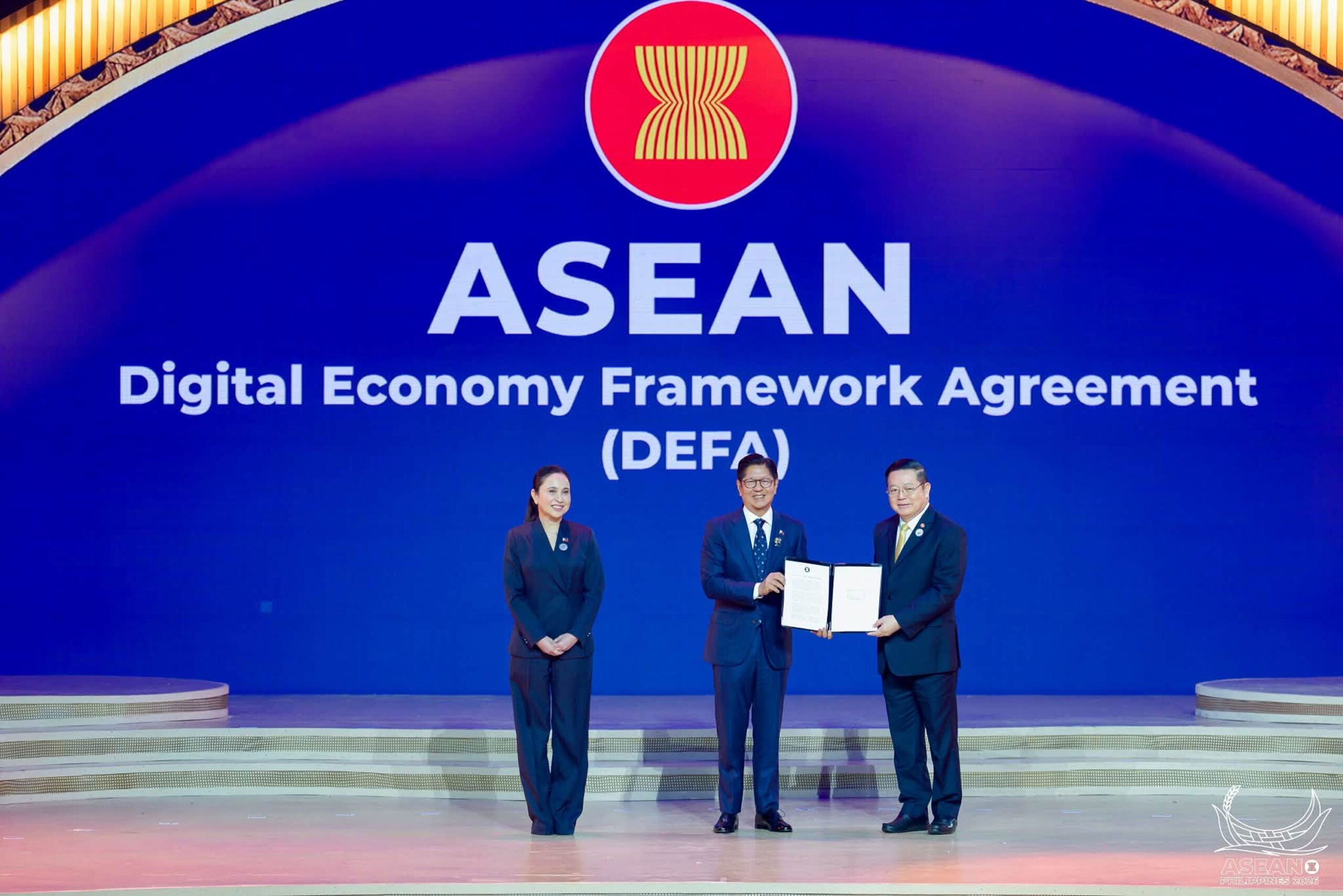
Philippine President Ferdinand Marcos Jr. hands over the ASEAN Digital Economy Framework Agreement (DEFA)—the world’s first region-wide digital economy agreement—to ASEAN leaders during the opening of the 49th Summit at the PICC on November 15, 2026.
This is AI-generated. Read the article for full context. Report any errors.
MANILA, Philippines – Members of the Association of Southeast Asian Nations (ASEAN) have signed the ASEAN Digital Economy Framework Agreement (DEFA), the first region-wide agreement of its kind.
Signed by ASEAN’s 11 member-countries on Saturday, November 14, DEFA establishes common rules for digital trade in a market of nearly 680 million people. Negotiations began in 2023, with the agreement becoming a priority deliverable of the Philippines’ ASEAN chairmanship this year.
“DEFA is not simply about economic growth. It is establishing the rules, systems, and cooperation that will allow our people and businesses to participate more fully in that growth,” Trade Secretary Cristina Roque said during the signing ceremony on Saturday.
Roque also said DEFA could help ASEAN’s digital economy grow from an estimated $1 trillion to $2 trillion by 2030.
At a high level, DEFA hopes to establish an “interconnected ASEAN digital marketplace,” with a framework covering cross-border e-commerce, electronic payments, protection of source code, cybersecurity, online consumer protection, and cooperation on emerging technologies such as artificial intelligence. It’s another step in ASEAN’s long-held aspiration of economic integration, though critics say progress toward a single market and production base has been painfully slow.
“DEFA will facilitate paperless trading, cross-border e-commerce, and trusted cross-border data flows, and it will establish interoperable trade systems,” ASEAN Secretary-General Kao Kim Hourn said at the ASEAN Business and Investment Summit on Saturday.
In practical terms, that means lower transaction costs, simpler cross-border operations, and…
文章开头,摘自Rappler。如需阅读全文,请前往媒体网站。
MarketNews 仅展示媒体发布的标题和摘要,全文请在出版方网站阅读。 (www.rappler.com)