A dead star is flashing radio waves every 8 minutes, and its partner looks a lot like the Sun
Detailed summary
Slowly blinking radio signals from space have puzzled astronomers since 2022.
Since 2022, astronomers have been puzzling over a new kind of cosmic object called long-period radio transients.
These are objects that emit bright flashes of radio waves into space every few minutes to every few hours.
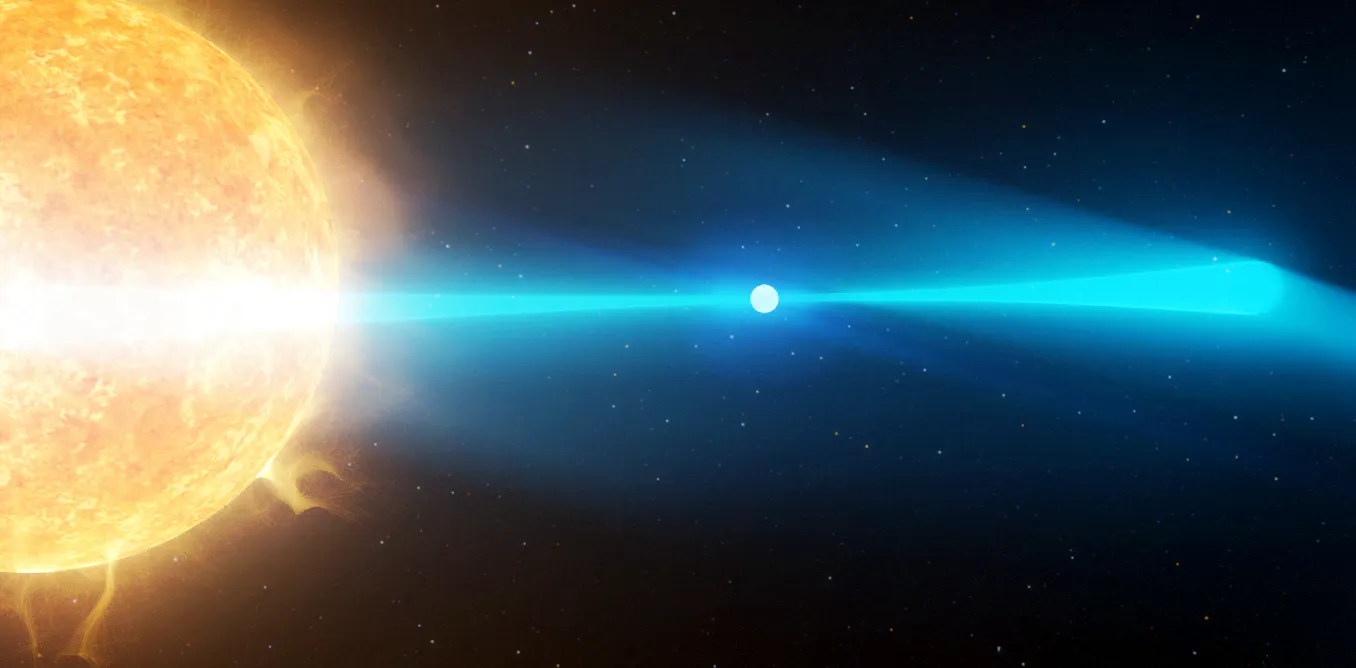
Some have been traced back to binary systems of a small, dim cool star called a red dwarf in orbit with a star remnant called a white dwarf.
In new research published today in Nature Astronomy, we report the first discovery of a different source for one of these enigmatic intermittent broadcasters: it still involves a white dwarf, but also a star much like our own Sun.
After the discovery of the first long-period radio transient in 2022, once we had ruled out aliens, we went looking for natural explanations.
One idea was that they were extremely slow-spinning neutron star pulsars, the collapsed cores of enormous stars which also send out repeating radio flashes. But in theory a neutron star spinning that slowly shouldn’t produce radio waves, so the answer had to be something else.
When we started traced these radio signals back to their sources, we made a breakthrough. One of our repeating signals came from a red dwarf star, probably orbiting a white dwarf (the remnant of a star like our Sun).
Across the handful of long-period transients whose source stars we can identify, a pattern has emerged: a binary system of a white dwarf and a small, cool red dwarf.
In late 2024, we were looking for new long-period transients using the Murchison Widefield Array radio telescope in Western Australia.
Opening of the article, excerpted from The Conversation AU. To read the rest, open the article on the publisher's site.
MarketNews shows the headline and summary published by the outlet. The full article is on the publisher's website. (theconversation.com)