SpaceX Starship megarocket blasts off before expected return for reuse
Detailed summary
Flight 15 expected to orbit Earth about 14 times over 22 hours, before company catches it at Starbase, TexasSpaceX’s Starship megarocket blasted off from Texas on Friday afternoon…
Flight 15 expected to orbit Earth about 14 times over 22 hours, before company catches it at Starbase, Texas
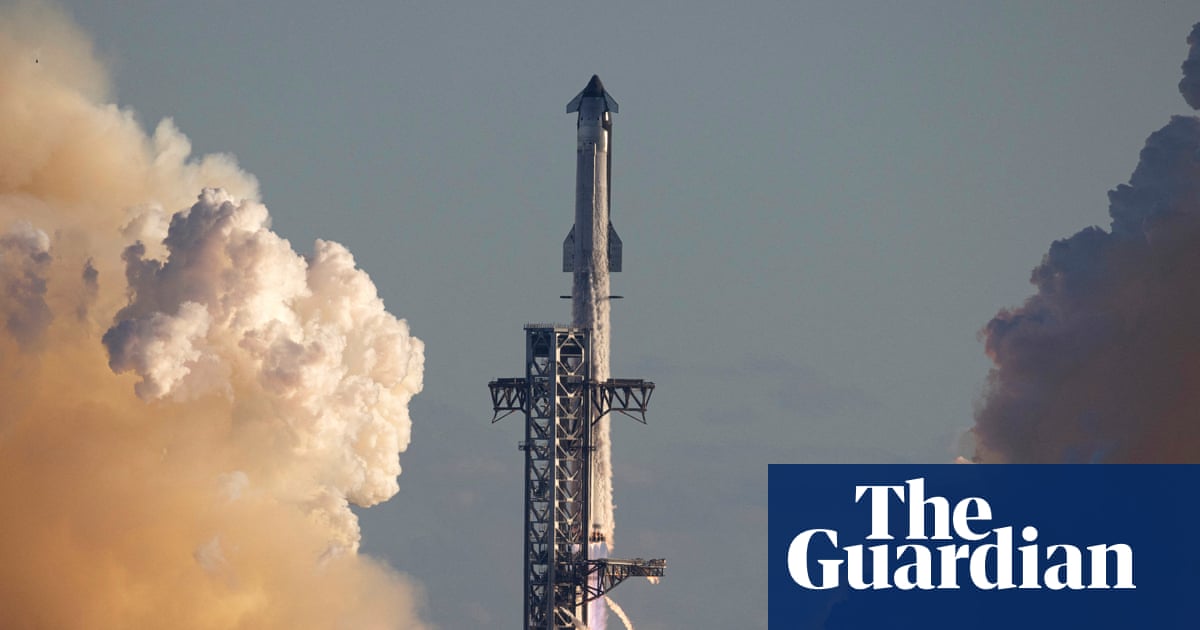
SpaceX’s Starship megarocket blasted off from Texas on Friday afternoon as the aerospace company sought to make history with a double catch of its reusable rocket, but ultimately fell short.
Starship, the world’s largest rocket, standing at 407ft, is expected to orbit Earth about 14 times over the course of 22 hours, before the company catches the rocket at its launchpad at Starbase in south Texas.
The rocket, which is on its 15th flight, is composed of two elements: the lower booster, with 33 Raptor engines that fired off during takeoff, and the Starship at the top.
As smoke plumes wafted from the launch site, SpaceX employees erupted into cheers.
SpaceX had planned for both components to return to its tower, but the booster, named Super Heavy, was aborted, and splashed down in the Gulf of Mexico. The cause of that diversion remains unknown.
“That certainly isn’t the news that we had hoped to hear for today,” said Kate Tice, SpaceX’s director of quality management, but she noted the booster’s return was in line with “rigorous safety checks”.
Early in the webcast, SpaceX simulated the return. The entire rocket was expected to be grabbed in the launch tower’s “chopstick” mechanical arms.
Friday’s test did not rise to the double-catch mantle, which Elon Musk had described early in November as a “critical breakthrough needed to make life multiplanetary”.
Opening of the article, excerpted from The Guardian Business. To read the rest, open the article on the publisher's site.
MarketNews shows the headline and summary published by the outlet. The full article is on the publisher's website. (www.theguardian.com)