Policing protests: how France’s student movement echoes the political crisis in Kanaky‑New Caledonia
Résumé détaillé
Two researchers explore the parallels between how the police handle mass protest rallies and maintain public order in France and its overseas territories during peak periods of civil unrest.
Protests are ongoing in France, but also on a European scale, as young people, the so-called “Gen Z”, are protesting in Greece, Spain, and other countries. Here, we explore the forces behind protests in France and draw parallels with earlier events in its semi-autonomous Pacific territory Kanaky-New Caledonia (KNC).
The mass protests we are witnessing this autumn in France are rooted in the global environmental and economic crisis, bleak future prospects, according to economist Yann Algan, and a lack of university places and funding for education. Protests by high school students, calling for better conditions such as the replacement of absent teachers, consistent heating in schools in winter, and smaller classes have been relatively peaceful.
On October 17, 500,000-800,000 people demonstrated in France; on November 5, up to 1.6 million. There were violent clashes between police and so-called casseurs, who, mostly apolitical, became radicalised in the face of discrimination, inhospitable immigration politics, and school failure, and have destroyed infrastructure and looted supermarkets, also attacking schools and public buildings such as Limoges’ historical neo-Renaissance town hall.
We have identified four parallels in terms of protest and state response with the insurrection in Kanaky-New Caledonia in May 2024, when pro-independence demonstrations against an electoral bill turned violent and resulted in 14 deaths (12 citizens, mostly young Kanak activists, and 2 policemen) and the destruction of businesses, schools, and other infrastructure.
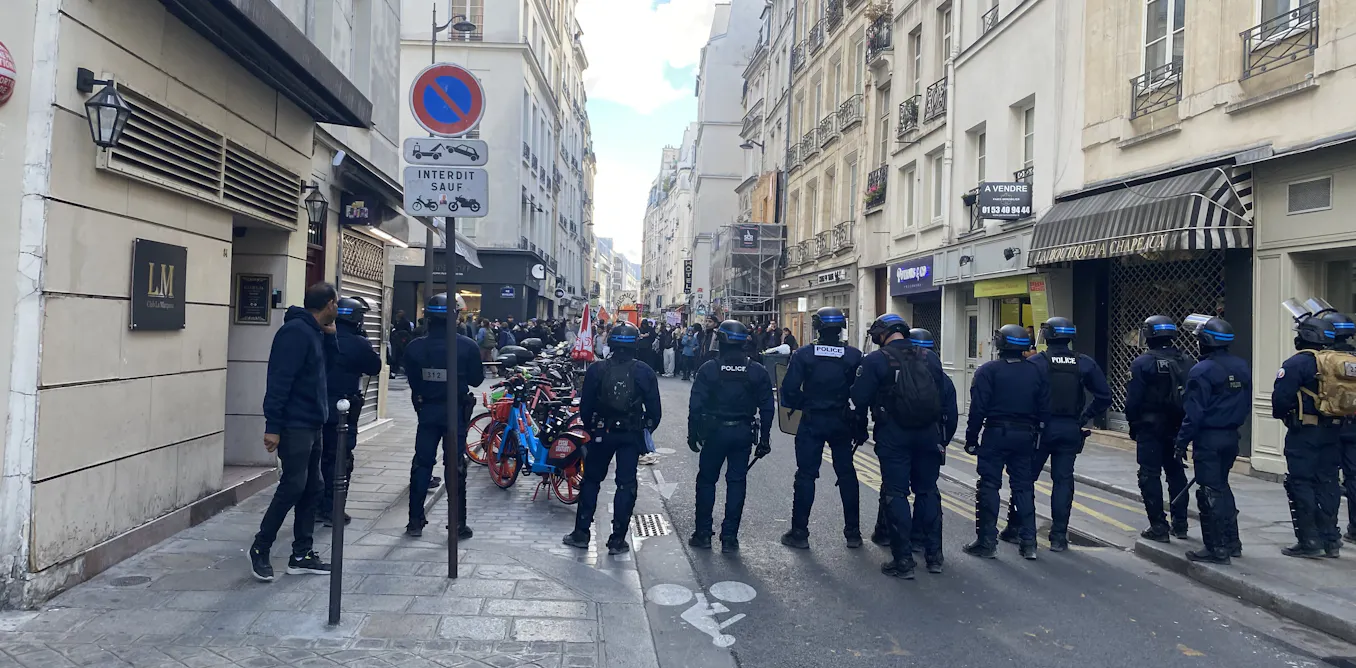
The first parallel is how the French centre-right government responded to dissent not with dialogue, but with military-style repression to reclaim “public order”. In one week, more than 5,000 students – many of them minors – were arrested, more than in any other social movement in France’s history. This was perceived as intimidation.
Several schoolchildren were severely injured, leading to even stronger dissent in which “yellow…
Début de l'article, extrait de The Conversation AU. Pour lire la suite, ouvrez l'article chez le média.
MarketNews présente le titre et le résumé publiés par le média. L'article complet se lit sur le site de l'éditeur. (theconversation.com)