Russia outlines how mobile hospitals can keep healthcare running during war
Résumé détaillé
Deployable medical teams, field operating theatres and AI-assisted casualty planning are among measures used to support hospitals facing mass casualties and disrupted supplies ...
A hospital facing a sudden influx of 150 severely injured patients within half an hour may not have enough beds, operating facilities or medical staff to treat them all. In a war, the challenge can be even greater when electricity, water, transport and medical supplies are also disrupted.
Russia is using mobile hospitals, deployable specialist teams and a nationwide emergency medical coordination system to help civilian healthcare services cope with such scenarios, according to Professor Aleksei V. Osipov, director of the country's Federal Centre for Disaster Medicine.
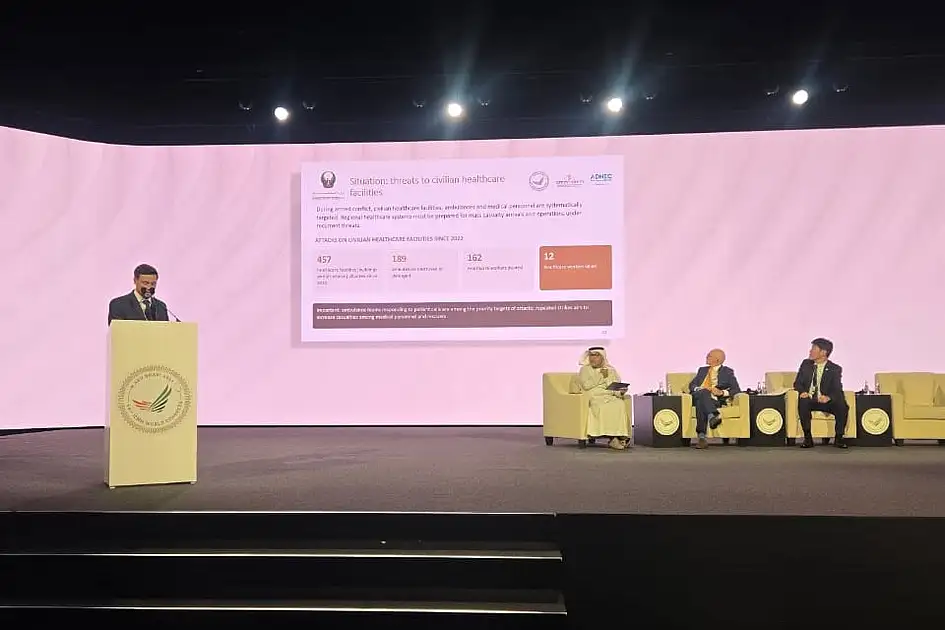
Speaking at the International Congress of Military Medicine in Abu Dhabi last week, Osipov described how the system connects regional hospitals and ambulance services with federal resources, allowing medical teams, evacuation support and mobile operating facilities to be deployed when local healthcare capacity is overwhelmed.
"Not only the number of patients is the problem; the problem is with energy, with the water, with the supply chains," he said, highlighting the multiple pressures hospitals face during armed conflict.
A slide in his presentation listed 457 healthcare facilities damaged or destroyed since 2022, alongside 189 ambulances damaged or destroyed, 162 healthcare workers injured and 12 killed. The geographical scope of these figures was not specified.
Osipov stressed that damage to a hospital affects more than its ability to treat casualties.
"Each damaged facility represents more than also building and equipment," he said, explaining that it also reduces access to everyday healthcare for the surrounding population.
The scale of the operation is reflected in figures presented by Osipov: more than 1,200 specialists have served in deployable medical teams, providing care to over 297,000 patients and performing more than 12,500 surgical procedures.
One of the key capabilities Osipov highlighted was a network of mobile medical complexes, including hospitals, operating theatres and laboratory…
Début de l'article, extrait de Khaleej Times. Pour lire la suite, ouvrez l'article chez le média.
MarketNews présente le titre et le résumé publiés par le média. L'article complet se lit sur le site de l'éditeur. (www.khaleejtimes.com)