Commentary: ASEAN must hold the line on Five-Point Consensus for Myanmar’s reintegration
Résumé détaillé
Myanmar’s political reintegration into the Southeast Asian bloc should follow demonstrable progress, not be offered in the hope that progress will follow, says Joanne Lin from the…
Myanmar’s political reintegration into the Southeast Asian bloc should follow demonstrable progress, not be offered in the hope that progress will follow, says Joanne Lin from the ISEAS-Yusof Ishak Institute.
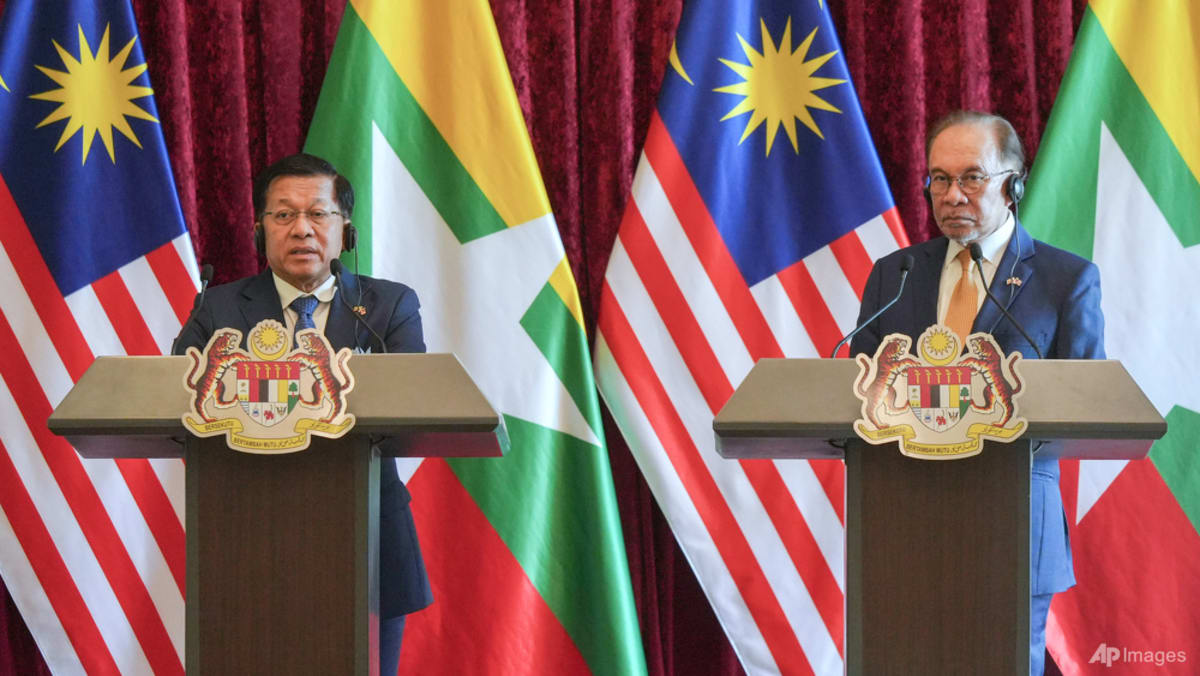
SINGAPORE: Malaysian Prime Minister Anwar Ibrahim received Myanmar leader Min Aung Hlaing in Kuala Lumpur in October and said Malaysia would work toward Myanmar’s “full reintegration” into the Association of Southeast Asian Nations (ASEAN). His remarks sharpened a question the 11-member grouping can no longer avoid.
Since April, Min Aung Hlaing has been received by Laos, Thailand, Cambodia, Vietnam and Malaysia. Myanmar’s bilateral relations with a growing number of ASEAN members are becoming more normal, even as its political representation at ASEAN summits and meetings remains restricted.
ASEAN will not be able to reverse these contacts. Engagement with Naypyidaw is necessary for practical reasons and is also part of any attempt to implement ASEAN’s Five-Point Consensus (5PC), the peace plan agreed after the 2021 military coup.
However, the grouping needs to distinguish between engagement, bilateral normalisation and collective reintegration.
That distinction is not always easy to draw. ASEAN members have their own economic and political reasons for maintaining functioning bilateral ties.
Thailand needs channels to manage a long border, refugees, migrant labour, trade and transnational crime. Malaysia needs cooperation on repatriations, having sent back more than 10,000 Myanmar nationals so far amid concerns that refugees had become a financial burden and security risk.
Practical necessity can justify engagement. Engagement does not in itself amount to normalisation, but repeated high-level contacts and state-level treatment can gradually contribute to it.
But bilateral engagement cannot determine Myanmar’s political standing in ASEAN. That remains a collective decision.
Début de l'article, extrait de CNA. Pour lire la suite, ouvrez l'article chez le média.
MarketNews présente le titre et le résumé publiés par le média. L'article complet se lit sur le site de l'éditeur. (www.channelnewsasia.com)