Pilotless air taxis could fly tourists on Thailand's Phuket island as early as next year
Detailed summary
Pilotless drone taxis could fly tourists between Phuket's airport and the city center in about eight minutes as early as next year, at 2,000 baht (US$59) per passenger.
Sithidej Mayalarp, chief executive of Stock Exchange of Thailand-listed aviation technology firm Sky ICT, said his group plans to introduce autonomous drone taxi services at Phuket International Airport by 2027, pending the readiness of the regulatory framework, the Bangkok Post reported.
Commercial deployment could take place as early as next year, subject to the completion of regulations and approval from the Ministry of Transport, he said. The company expects business models and feasibility studies for the plan to be completed by the end of this year.
The service targets high-spending foreign tourists seeking premium transfers directly to beachfront hotels, and Sithidej said he anticipates strong passenger uptake driven by the novelty of the flight.
The launch hinges on the Civil Aviation Authority of Thailand (CAAT), which has prepared draft rules for advanced air mobility, the category that covers electric vertical take-off and landing (eVTOL) aircraft. The agency will consult industry stakeholders and the International Civil Aviation Organization before issuing them, Siamrath reported.
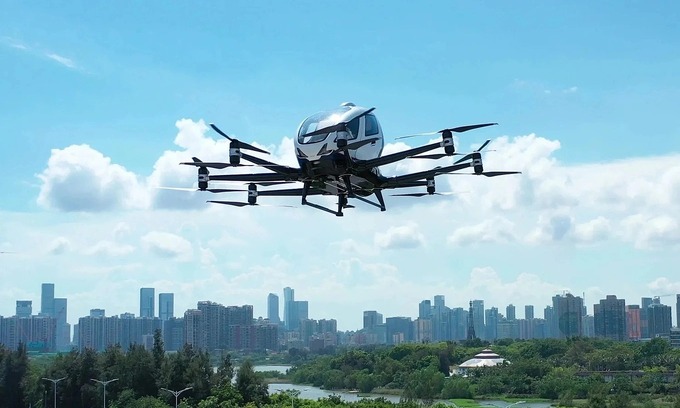
Sky ICT is not the only company eyeing Phuket. Chinese eVTOL maker EHang has flown its pilotless EH216-S aircraft in Bangkok under a CAAT sandbox program and lists Phuket, Pattaya and Koh Samui among planned destinations, though CAAT has set no date for commercial ticket sales.
A pilotless EH216-S passenger aircraft made by China's EHang in flight. Photo courtesy of EHang
Beyond air taxis, Sithidej said the group's two-year strategy includes automated service robots at Suvarnabhumi, Don Mueang and Phuket airports, with humanoid robots to assist arriving travelers and handle luggage at Suvarnabhumi by 2028.
The group recently set up Nurix Co, a joint venture with Thai technology retailer COM7 and Chinese robotics company AgiBot. It holds a controlling 55% stake, with COM7 at 35% and AgiBot at around 10%.
The group has imported more than 20 robots from China, which are being programmed…
Opening of the article, excerpted from VnExpress International. To read the rest, open the article on the publisher's site.
MarketNews shows the headline and summary published by the outlet. The full article is on the publisher's website. (e.vnexpress.net)