China fast-tracks mobile ICBM to lock down second-strike edge
Résumé détaillé
China’s rapid operational integration of a new type of intercontinental ballistic missile (ICBM) underscores an accelerating push to modernize its land-based deterrent, addressing…
China’s rapid operational integration of a new type of intercontinental ballistic missile (ICBM) underscores an accelerating push to modernize its land-based deterrent, addressing key technical vulnerabilities of earlier systems while fortifying second-strike survivability amid an unprecedented nuclear expansion.
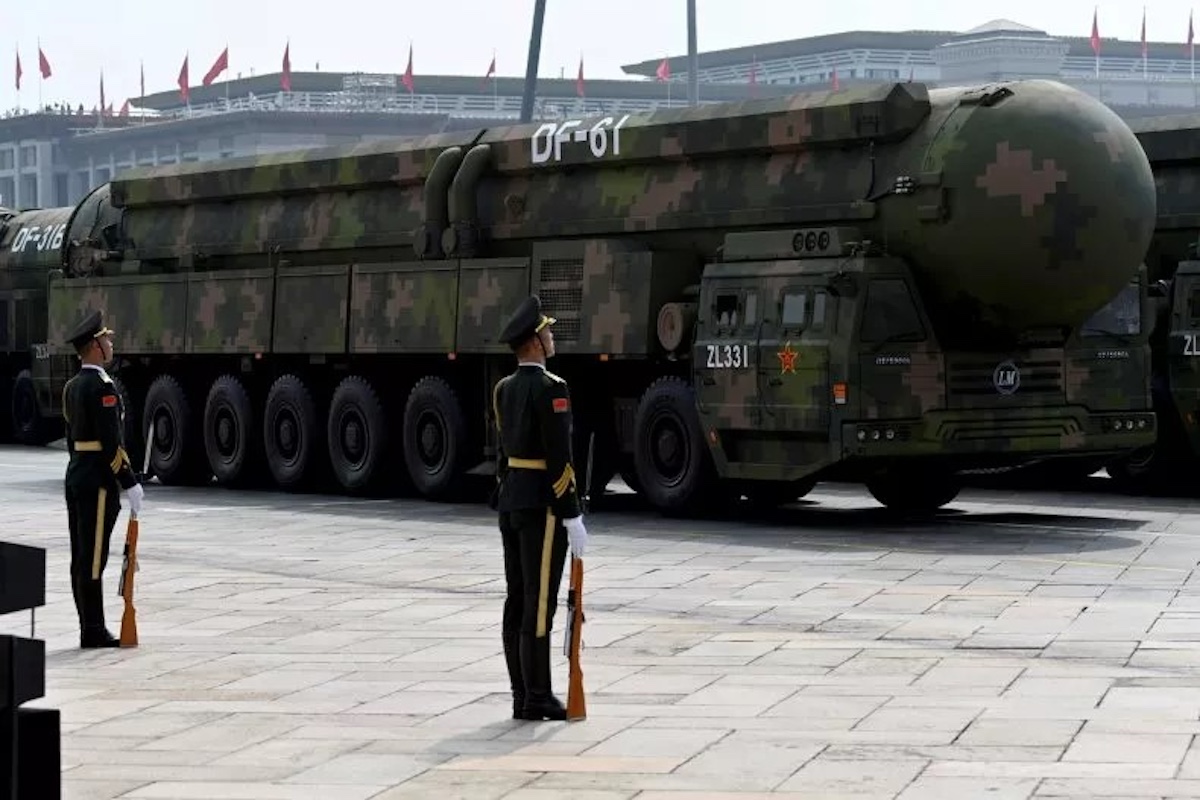
This month, multiple media outlets reported that China’s newest road-mobile ICBM, the DF-61, has entered routine training with the People’s Liberation Army Rocket Force (PLARF) just 14 months after its public debut, signaling a faster-than-usual integration into operational nuclear forces.
The missile first appeared during a September 2025 military parade and now participates in field maneuvers, repositioning drills, and simulated launch sequences. According to Chinese state media, the DF-61 completed development, design finalization, trial deployment and reliability testing before its public unveiling.
The rapid timeline likely stems from design continuity rather than an accelerated development cycle. Mounted on a 16-wheel transporter-erector-launcher (TEL) nearly identical to that of the older DF-41, the DF-61 is widely assessed as an evolutionary upgrade compatible with existing command, support, and training infrastructure.
While technical specifications remain classified, estimates suggest a solid-fuel range of 12,000 to 18,000 kilometers and multiple independently targetable reentry vehicle capability.
Dispersal training complicates adversary pre-launch tracking, reinforcing China’s second-strike survivability alongside expanding silo fields, though full operational readiness across active units remains unconfirmed.
Understanding the limitations of China’s older DF-41 ICBM provides clues on which technical and operational shortfalls the DF-61 is engineered to address. Missile Threat notes that the DF-41 is a three-stage solid-fuel ICBM capable of striking targets up to 15,000 kilometers away.
According to Missile Threat, the DF-41 measures between 20 and 22…
Début de l'article, extrait de Asia Times. Pour lire la suite, ouvrez l'article chez le média.
MarketNews présente le titre et le résumé publiés par le média. L'article complet se lit sur le site de l'éditeur. (asiatimes.com)