New images reveal crater on asteroid struck by DART spacecraft
Detailed summary
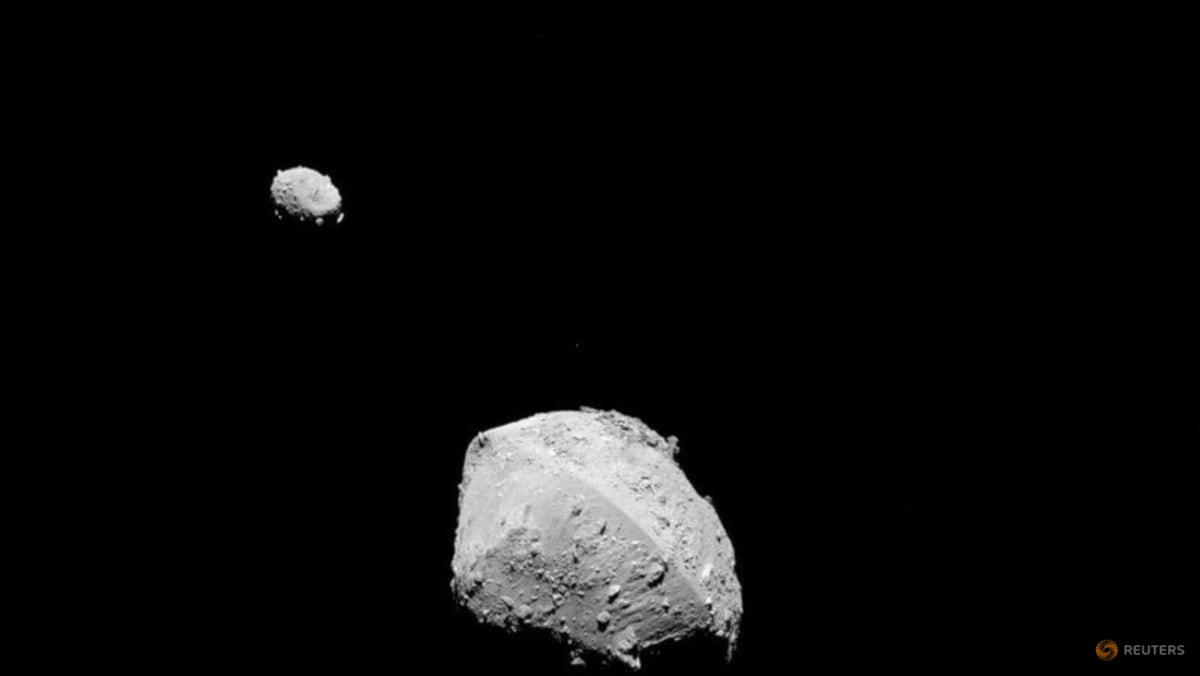
Nov 25 : Dimorphos, the small asteroid struck by NASA's DART spacecraft in 2022 in the first test of a planetary defense system, was left with one side flattened with a stadium-sized crater and is tumbling in space, as shown by images taken by the European Space Agency's Hera spacecraft released on Wednesday.
DART was sent on a proof-of-principle mission for using a spacecraft to change a celestial object's trajectory. Dimorphos, an oblong-shaped rocky object about 495 feet (151 meters) wide, orbits its companion asteroid Didymos, with a diameter of 2,395 feet (730 meters), and the pair is currently about 120 million miles (193.5 million km) from Earth.
They are defined as near-Earth asteroids, though neither object imperils Earth. Previous data showed how DART succeeded in changing the path of Dimorphos — demonstrating that a spacecraft could alter the trajectory of an object headed toward a collision with Earth. Hera is now getting a close-up look at how DART physically changed Dimorphos.
"The side impacted is now completely covered by a crater, with the visual impression that a piece of the asteroid was cut off by the impact. We do not see evidence for major changes on the site opposite to the DART impact. The combination of those two observations is surprising," Michael Kueppers, ESA's Hera mission scientist, told Reuters.
The big crater covers nearly the whole front side of Dimorphos as it continues its orbit of Didymos.
"Dimorphos is now tumbling in a chaotic way. There are hundreds of boulders floating around in the system," Kueppers said.
Hera, about the size of a small car, is presently observing Didymos and Dimorphos from a distance of about 15 to 19 miles (25 to 30 km). Hera next month is slated to approach within 8 miles (13 km) of the pair, obtaining increasingly higher-resolution images.
In January, Hera is due to deploy two shoebox-sized miniature satellites, called CubeSats, that will approach even closer for further study, including investigating the…
Hera'…
Opening of the article, excerpted from CNA. To read the rest, open the article on the publisher's site.
MarketNews shows the headline and summary published by the outlet. The full article is on the publisher's website. (www.channelnewsasia.com)